







What’s different between the oral form and the IV form?
Oral vitamin C is absorbed through the small intestine’s transporters, and these transporters have a saturation limit. No matter how much you take, the blood concentration caps out around 220 micromoles at most, and the surplus is passed out in urine or triggers diarrhea.
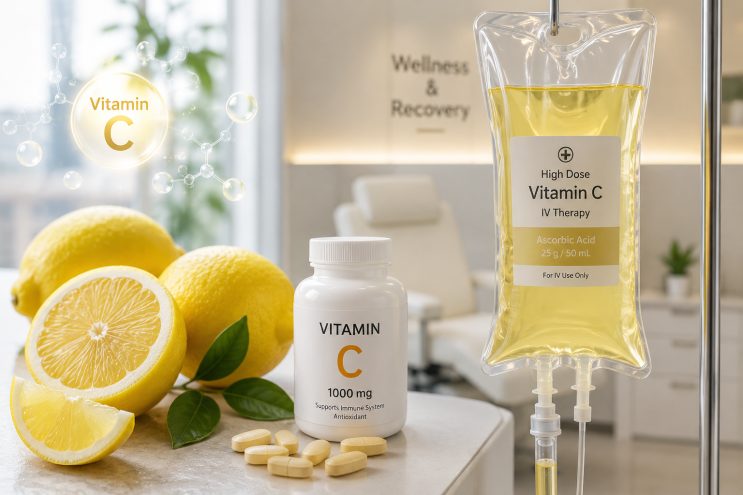
IV administration, by contrast, completely bypasses the digestive tract. Put in 10 g intravenously and the blood concentration can rise to over 15,000 micromoles. Only on reaching this pharmacological dose do the special mechanisms begin to work.
The timing of when you feel it differs as well. The oral form climbs gradually over days to weeks, while the IV form is often felt within a few hours right after administration.
When the dose changes, the mechanism changes
The key to understanding high-dose vitamin C is a single point: it’s the same substance, but as the concentration rises, the mechanism itself changes.
At a standard dose of 0.1 g to 1 g taken orally per day, the blood concentration sits at 70 to 220 micromoles and performs an antioxidant action that neutralizes reactive oxygen species. The purpose is everyday immune maintenance and nutritional supplementation. At a moderate dose of 1 g to 5 g given intravenously, the antioxidant effect strengthens and enhanced collagen synthesis is added. The goal is fatigue recovery and improved skin elasticity. At a high dose of 10 g to 15 g, powerful antioxidation and maximized collagen synthesis occur, and it is used alongside chelation or for anti-aging purposes.
If a standard dose is a shield, a high dose is a reinforced shield with a repair agent added on.
In the ultra-high-dose range of 25 g and above, an interesting reversal takes place. Vitamin C, which had been an antioxidant, switches its mechanism to a pro-oxidant, generating hydrogen peroxide, and abnormal cells lacking the catalase enzyme are selectively damaged (Chen et al., PNAS, 2008). That said, this range is still an area under active research, so it should be viewed separately from the scope covered in ordinary anti-aging care.

The three effects of a high dose
First, it promotes collagen synthesis. Vitamin C is an essential cofactor for collagen synthesis. It is directly involved in the hydroxylation of proline and lysine, and without this process collagen cannot form its normal structure. This is why it affects not only skin elasticity but also the structural stability of vessel walls.
Second, it modulates immune function. It strengthens the function of neutrophils and lymphocytes and regulates the overproduction of inflammatory cytokines. The scientific basis for the common notion of “vitamin C for a cold” is precisely this mechanism.
Third, it improves fatigue. A domestic family-medicine study reported that a group given high-dose intravenous vitamin C showed a significant reduction in reactive-oxygen-species levels and fatigue compared with a placebo group (Suh et al., Korean J Fam Med, 2012).
Why it’s used together with chelation
A high-dose vitamin C drip is often administered together with a chelation drip. This is because of two synergies.
A chelation drip works by binding heavy metals in the body and calcium deposits on vessel walls and excreting them. In this process, however, oxidative stress can temporarily increase. Adding high-dose vitamin C here buffers the oxidative stress and, at the same time, its collagen-synthesis-promoting effect supports the recovery of the cleaned-out vessel walls.
Cleaning out and rebuilding — the effect grows when these two roles mesh. For reference, chelation’s cardiovascular benefit was reported as a significant result in patients who had a heart attack with accompanying diabetes in the TACT study (Lamas et al., JAMA, 2013), but the overall level of evidence is still under discussion.
Precautions you must check
G6PD deficiency must be confirmed by prior testing. If you have glucose-6-phosphate dehydrogenase deficiency, hemolytic anemia can occur after a high dose. It’s a rare genetic condition, but before the first session testing is required without exception.
The risk of kidney stones is checked as well. Oxalate is produced during vitamin C metabolism, and if it binds with calcium, kidney stones can form. If you have a history of kidney disease or a past record of stones, you must consult a medical professional.
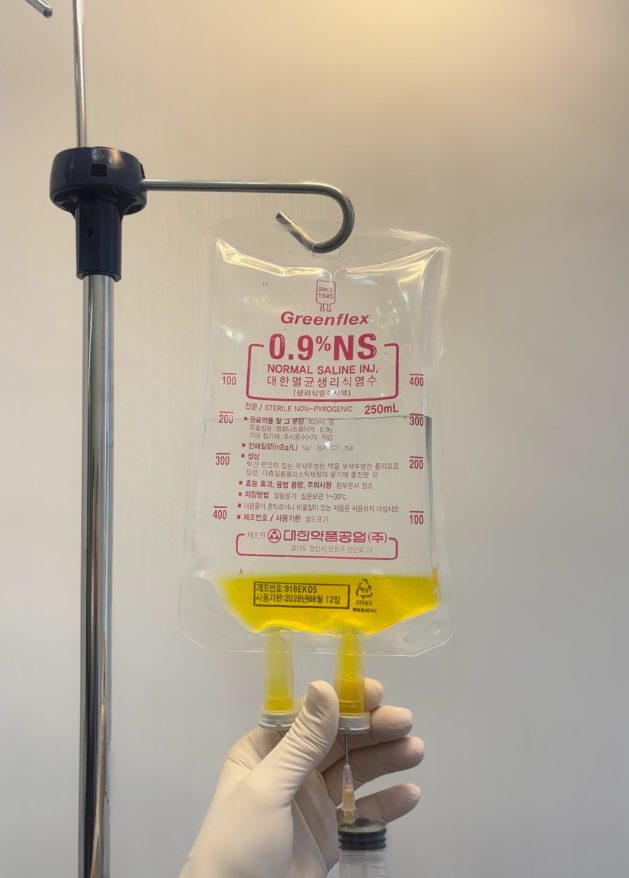
Before drip therapy, we check a basic blood test, a G6PD test, kidney-function tests such as creatinine and eGFR, and chronic-inflammation markers. If possible, a hair mineral test alongside these is also helpful.
Some people say, “At other places they just gave it to me.” But a G6PD deficiency isn’t absent just because it’s rare. Once confirmed, it’s information you carry for life, and if it isn’t confirmed, a problem arises at the very first session. This test, at least, is one I never skip.