







How do I tell simple muscle soreness from a warning sign?
Knee pain in your 50s is a symptom that covers the tenderness, stiffness, clicking, and swelling that arise in and around the knee during exercise or daily life. Behind it hide a range of causes, from mild ones that heal in a few days to deep damage that requires surgery. The most dangerous thing is the habit of self-diagnosing every pain as the same muscle soreness.
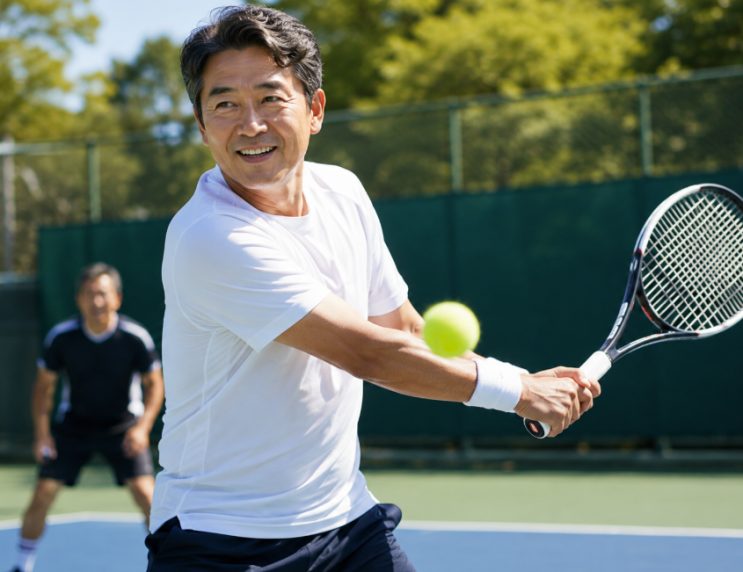
A 2019 study published in Osteoarthritis and Cartilage (Culvenor AG et al.) reported that in people aged 45 and over, the natural wear of knee cartilage accelerates, and more than half show damage on MRI even without pain. It means that no pain doesn’t mean the knee is fine, and that once pain begins, it may be the surface signal of changes already in progress.
Signal one: pain that recurs with a specific movement. A heavy feeling in the legs right after exercise is common. But if the same spot hurts with the same movement — going down stairs, standing up from the toilet, getting out of a car, sitting cross-legged — it can be a signal of a structural problem.
Signal two: a clicking sound or a catching feeling. If you hear a click when you move your knee, feel a sudden catch, or have moments when it won’t straighten, these are classic signs of a meniscus tear. The meniscus is the C-shaped tissue that acts as a cushion inside the knee; from your 50s, when it has weakened with age, even a small twisting motion can tear it.
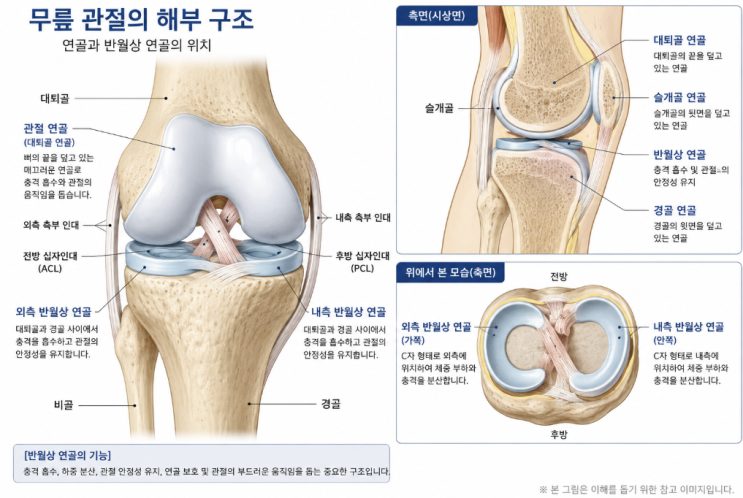
A 2020 meta-analysis published in the British Journal of Sports Medicine (Snoeker BAM et al.) reported that the rate of arthritis progression after 5 years differed by about twofold between the group that detected and managed a meniscus tear early and the group that ignored it and kept up their activity.
Signal three: swelling that recurs after exercise. If your knee is swollen like a water balloon, it’s a direct signal that something inside the joint is being irritated. It means synovial fluid is being over-secreted, or there is minor bleeding or inflammation. Don’t be reassured just because it subsides after a few days’ rest. The very pattern of recurring swelling is evidence that damage is accumulating.
If two or more of the three signals apply to you, you should stop self-diagnosing.
What happens if I keep playing through it?
There are clear signals at each stage. But the more you love exercise, the later you tend to notice those signals.
Stage 1 is mild tenderness. It’s at the level of “I’m a bit stiff after exercise,” and it fully recovers with a few days’ rest and strengthening. Stage 2 is recurring pain and swelling. This is the “I can play if I tape it up” zone, and if you get a diagnosis and adjust your activity, you can keep exercise for life. Stage 3 is meniscus damage. This is the point of “sometimes it strangely won’t straighten,” and if caught early, non-surgical options remain. Stage 4 is cartilage wear and accelerated arthritis. It’s the “if I play for an hour, I can’t get up the next day” stage, where regenerative injections and exercise therapy must go together. Stage 5 is advanced arthritis and meniscus tear, requiring arthroscopic surgery or more.
The most heartbreaking thing is that if you come in at stage 1 or 2, there is clearly a path to keeping exercise as a lifelong companion. Yet the more passionate someone is about exercise, the more they endure until stage 3 or 4. By that point, the options are greatly reduced.
There’s one more thing you must know. The meniscus has almost no blood vessels, so once it tears, natural recovery is nearly impossible. That’s why, for exercise enthusiasts in their 50s, early detection decides the future of your knee.
Which clinic should I go to?
The heart of good knee care is not a flashy menu of procedures, but a diagnostic process that accurately pinpoints the cause of the pain first with basic exams. Unfortunately, when people go to a clinic for knee pain in their 50s, it’s not rare to be urged to “try one injection” just five minutes into the consultation.
Even the same knee pain can have vastly different causes. Muscle tension, patellar tendinitis, meniscus tear, cartilage wear, Baker’s cyst, ligament damage — it could even be referred pain coming down from the lower back. If the cause is different, the treatment must be completely different.
Here’s what to check when choosing a clinic. Whether they perform X-ray and ultrasound at the first visit, whether they ask about your type of exercise, the nature of the pain, and since when, whether they explain the diagnosis together with its cause, and whether they guide you through exercise, medication, procedures, and surgery step by step. Conversely, if they recommend a procedure right away without exams, end it by saying it’s just aging and can’t be helped, or immediately push an expensive procedure package, you should think twice.
Among the people who come in saying “another place told me it’s just aging and can’t be helped,” there are truly many cases where a fully treatable cause — such as a meniscus tear or patellar tendinitis — turns out to be behind it. These are diagnoses that get missed if you don’t look closely.
X-ray and ultrasound — why do I need both?
The two exams look at completely different areas. X-ray shows the bone and the joint space. It’s essential for checking the KL grade of the arthritis stage, bone spurs, and leg alignment. Ultrasound shows cartilage, ligaments, tendons, and fluid buildup. A big advantage is that it can look directly at the painful area while moving the knee in real time.
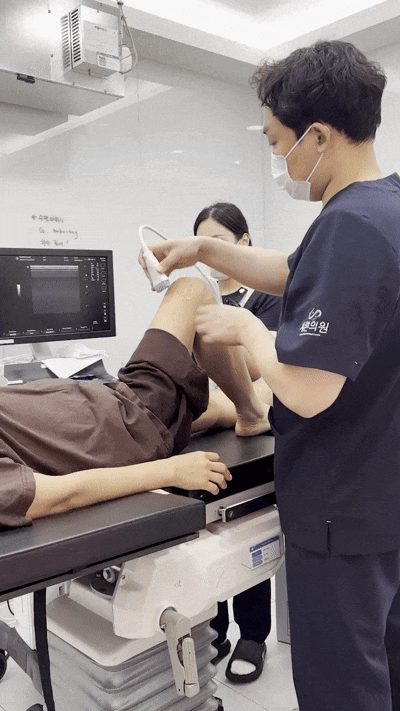
With X-ray alone, it’s easy to miss the cause when the bone looks fine but there’s pain; with ultrasound alone, it’s easy to miss the overall extent of arthritis progression. You need both exams together to reach an accurate diagnosis.
How to keep exercising while protecting your knee
The key is the balance of protecting the knee while giving it a moderate load. Resting completely causes muscle to waste away, which actually increases the burden on the knee, while overdoing it accelerates the damage.
First, maintaining the strength of the muscles around the knee, including the quadriceps. This is because the muscles share the impact. Second, temporarily leaving out movements that cause pain and replacing them with another approach. Third, spending time on warm-up and cool-down before and after exercise, and fourth, weight management. Losing just 1 kg reduces the load on the knee by about 4 kg. Finally, checking without delay when a signal comes.
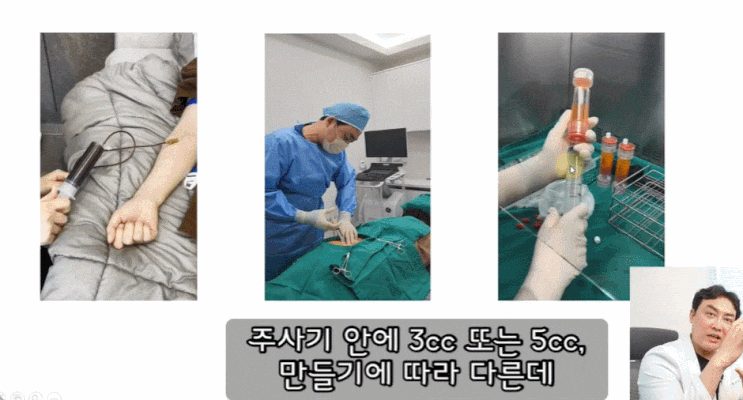
If you’re assessed at stage 3 or 4, regenerative injections such as PRP, BMAC, or SVF come into the options. But even that is a story that follows diagnosis. Not a procedure for its own sake, but weighing first whether it’s truly the necessary stage — that ultimately produces a better result.