







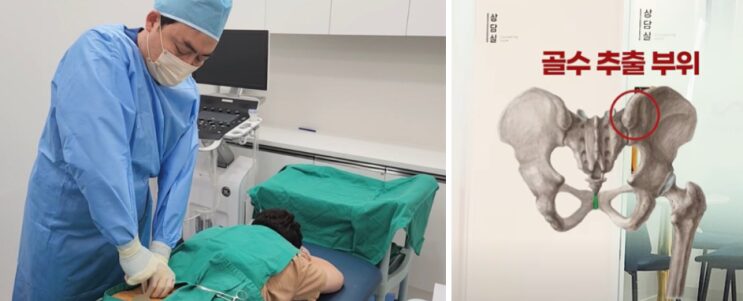
Where are stem cells drawn from? — Bone marrow vs. fat
Arthritis stem cell treatment has, broadly, two harvest routes: a method that harvests from bone marrow and a method that extracts from fat.
Bone marrow method (BMAC)
Bone marrow is harvested from the pelvic bone (iliac crest), centrifuged, and then injected into the knee joint. Beyond stem cells, it’s a combination package that also includes growth factors and immunomodulatory cells. It was designated a New Health Technology by the Ministry of Health and Welfare in 2023.
Fat method (SVF)
It’s extracted from abdominal fat. In terms of concentration, it is often more advantageous than bone marrow. That’s because as you age, the stem cell concentration in bone marrow decreases, whereas fat tends to retain its density relatively well. For this reason, there are cases where the fat method is more suitable for older patients.
Rather than one being unconditionally better, it’s right to decide by looking together at the patient’s age, the stage of arthritis progression, and overall systemic condition.
| Category | Bone marrow (BMAC) | Fat (SVF) |
|---|---|---|
| Harvest site | Pelvic bone (iliac crest) | Abdominal fat |
| Stem cell concentration | Relatively low, decreases with age | 100–1,000× that of bone marrow, less affected by age |
| Components included | Mesenchymal stem cells + immunomodulation + growth factors | Mesenchymal stem cells + immunomodulatory cells (high concentration) |
| Certification | 2023 New Health Technology designation | Clinical use at Advanced Regenerative Medicine facilities |
| Suitable cases | Intermediate stage, balance of anti-inflammation and regeneration | Older age, cases needing regenerative potential |
PRP combination — fertilizer for the stem cells
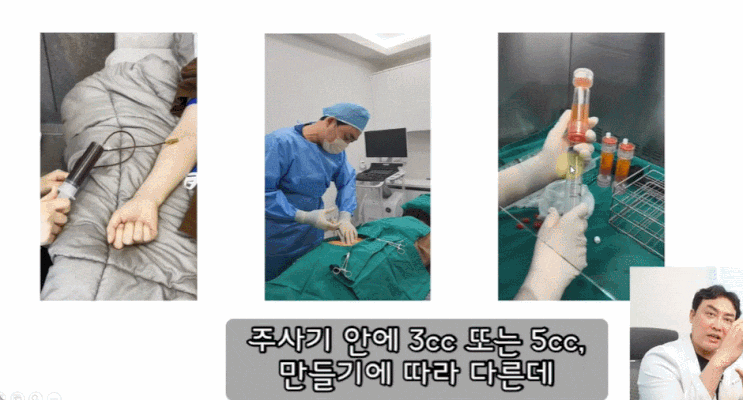
After examination, depending on the case, treatment may also combine PRP. A PRP (Platelet-Rich Plasma) injection is a method in which the patient’s own blood is drawn, only the platelets are concentrated with a centrifuge, and then injected into the knee. It acts as a promoter that controls inflammation and maximizes the tissue’s natural healing capacity.
If the knee’s degeneration has entered an intermediate stage, I sometimes recommend a combination treatment that creates synergy by sowing the seed of stem cells while also spreading the fertilizer of PRP.
Does cartilage fully regenerate?
I’ll tell you this part precisely. It’s difficult to say it returns to complete cartilage like in your 20s. Because cartilage is a tissue without blood vessels, complete natural regeneration is inherently difficult to begin with.
The goal of stem cell treatment is not restoration but reinforcement.It reduces inflammation at the damaged site and creates an environment for cartilage regeneration, thereby lowering pain and maintaining joint function. In practice, changes such as the defect filling in or cartilage thickness increasing are sometimes observed after treatment, and many people report that their everyday discomfort has decreased.
However, it takes time for these changes to appear. It’s not a procedure where the pain vanishes the very next day after the injection. It usually takes about 3 to 6 months for the stem cells to settle in and take effect.
If you need a fast effect, a treatment other than stem cells may suit you better. For example, if your pain is closer to the acute phase, it’s reasonable to first calm the inflammation and pain with PRP alone.
What you must check before getting treatment
① Sterile environment and equipment
Stem cells are highly sensitive to temperature and contamination. It’s not simply about giving an injection—it’s important to confirm whether the place is properly equipped with a sterile environment and dedicated equipment (centrifuge, cell-separation system, temperature-control device).
② Pre- and post-procedure care program
If you have diabetes or chronic inflammation, also ask whether a pre- and post-procedure care program is carried out alongside. If the inflammatory environment remains as it is, the effect can be cut in half.
③ Checking indications — it’s not recommended for everyone
To be honest, I do not recommend stem cell treatment to everyone who comes in for a consultation. That’s because if arthritis has progressed significantly or the leg alignment is greatly off, it can be hard to expect an effect. The first step is to accurately confirm whether your condition meets the treatment’s indications.

effect evaluation
New Health Technology designation
BMAC·SVF·PRP available
This is the story of a woman in her 70s who came in for a consultation last month. She had been advised to get bone marrow stem cells at another hospital, but she said bone marrow harvesting scared her and came to Saeron Clinic.
Looking at her overall condition along with the X-ray, it was late KL 3, with relatively good leg alignment. However, given her age, her bone marrow concentration was likely lowered. I told her honestly: “At this age, fat (SVF) is more advantageous than bone marrow in terms of concentration. Combining PRP with it also tackles the pain and inflammation together.”
At her checkup 4 months later, she was pleased that her walking distance had increased. The most important thing is to decide with enough information before receiving treatment.