







What is inflammaging?
Inflammaging refers to a low-grade, painless chronic inflammatory state that persists throughout the whole body as we age. It is a term proposed in the early 2000s by the Italian immunologist Franceschi, combining the words inflammation and aging.

The inflammation we commonly know is acute inflammation — when you’re injured or infected, the area turns red, swells, and gets hot. It’s a healthy response that subsides within a few days and leads to healing. Inflammaging, by contrast, is a state with almost no symptoms, in which only the inflammatory markers stay chronically and slightly elevated.
If acute inflammation is a fire properly caught on firewood, inflammaging is the ember still alive in the ash of a campfire you thought had gone out.
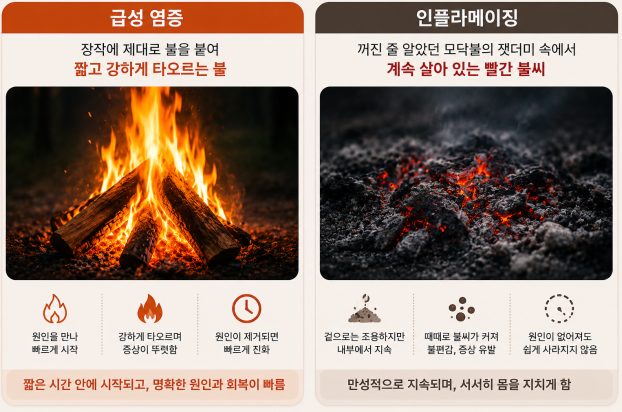
The two differ in many respects. Acute inflammation lasts from several days to several weeks, with clear heat, pain, and swelling, and CRP spikes sharply. Inflammaging continues from years to decades, has almost no symptoms, and shows hs-CRP, IL-6, and TNF-alpha chronically and slightly elevated. Acute inflammation plays the beneficial role of defense and healing, whereas inflammaging works in the harmful direction of tissue damage and accelerated aging.
How is it intertwined with immune aging?
To understand inflammaging, you have to look at immune aging alongside it. As we age, the number and function of immune cells gradually decline, and there are three notable changes.
First, thymic involution. The thymus — the immune military academy that trains rookie T cells — begins to shrink from puberty, and by the 50s to 60s it has mostly turned into fatty tissue. The supply of new T cells is effectively cut off. Second, a decline in immune-cell diversity. The cells that respond to new pathogens decrease while the proportion of cells that remember the past grows, so the response to a virus seen for the first time weakens.
The third is the key. Defensive capacity weakens, yet inflammatory signals actually increase. Aged immune cells fail to do their job while ceaselessly secreting inflammatory cytokines such as IL-6 and TNF-alpha. This phenomenon is called SASP, the senescence-associated secretory phenotype. To put it simply, it’s a state of doing no work while nagging more than ever.

This SASP spreads throughout the body and becomes the fuel for inflammaging. When immunity ages, inflammation increases; when inflammation increases, immunity ages even faster — a vicious cycle is created. Breaking this loop is the core task of anti-aging medicine.
What signals does my body send?
Inflammaging is not entirely asymptomatic. It’s just that the discomfort, though clearly there, is hard to describe, so it’s easy to write off as aging.
On the energy side, it’s hard to get up in the morning and chronic fatigue sets in during the afternoon. This connects to declining mitochondrial function. In recovery, a cold or a wound heals two or three times more slowly than before. On the cognitive side, brain fog appears where a word doesn’t come to mind right away, which is related to neuroinflammation. The skin loses elasticity, turns dull, and recovers from blemishes more slowly. The joints and muscles are stiff in the morning and recover more slowly after exercise. In metabolism, weight is hard to lose and abdominal fat increases, and in the gut, bloating, constipation, and diarrhea recur.
If three or more of these persist for more than six months, it’s worth considering the possibility that this is not simple aging but inflammaging in progress.
Which tests confirm it?
hs-CRP is the representative marker of systemic chronic inflammation; below 1.0 mg/L is considered safe, and above 3.0 mg/L is considered high-risk. IL-6 is an aging-related inflammatory cytokine; when it rises, mortality and dementia risk go up. Homocysteine mediates vascular and neural inflammation, and below 10 micromoles is recommended. The neutrophil-to-lymphocyte ratio is a simple systemic inflammation marker; above 3 raises suspicion of chronic inflammation. A gut-microbiome test may also be used to assess diversity and short-chain-fatty-acid-producing bacteria.
The gap in which, among people who are all 50, one looks like they’re in their 30s and another like their 60s comes from the lifetime cumulative amount of inflammatory stimulation. Fortunately, much of this cumulative amount is a controllable variable. On the accelerating side there are oxidative stress, exposure to UV and fine dust, smoking and heavy drinking, refined carbohydrates, chronic sleep deprivation, stress, gut-microbiome imbalance, visceral fat, and a sedentary lifestyle. On the slowing side there are the Mediterranean diet, regular aerobic exercise, adequate sleep, polyphenols, omega-3, and appropriate protein intake.
There’s an interesting study too. In research published in Aging Cell in 2022, when the gut microbiota of old mice was transplanted into young mice, inflammatory signals and inflammaging markers rose regardless of age. This means that when gut health collapses, systemic aging accelerates.
Three layers for putting out the quiet ember
The core of managing inflammaging is changing the environment in which inflammation arises and modulating the signals that aged cells produce. The approach of “just do this one thing” does not work.
The first layer is lifestyle and nutritional correction. The interventions with the most solid evidence are the Mediterranean diet and at least 150 minutes of aerobic exercise per week. The polyphenols and omega-3 in the diet directly suppress the NF-kappaB inflammatory signaling pathway, and exercise reduces visceral fat to lower the inflammatory cytokines of fatty tissue. Curcumin, resveratrol, omega-3, and vitamin D are supplement ingredients with well-established evidence. That said, it takes several months for effects to appear, and it’s hard to reverse oxidative stress that has already accumulated for more than 10 years.
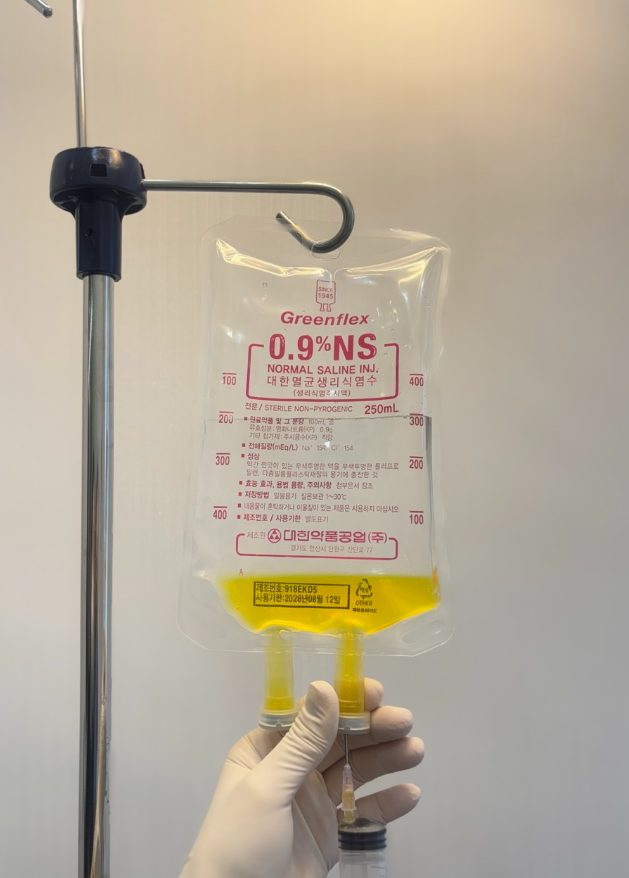
The second layer is tailored intravenous IV therapy. Oral supplements suffer large losses during digestion and absorption, but intravenous infusion can raise blood concentrations quickly and precisely. High-dose vitamin C addresses the oxidative-stress and tissue-recovery axis, and glutathione addresses the detoxification and mitochondrial-protection axis. It is meaningful when tests show abnormal findings.
The third layer is a regenerative-medicine approach. It targets cellular aging itself and the SASP environment, and it is considered when lifestyle and nutrition alone are not enough. It’s important not to skip the order. If you leave the environment where the ember stays alive as it is and stack only the upper layers, it won’t last long.
When I look at the hs-CRP of patients who come in saying “my checkup was all normal,” it’s not uncommon for it to exceed 3. That’s because standard checkups often don’t include high-sensitivity items. When I show them the number, only then do they say, “So that’s why.”