






Why is the scalp environment the problem?
In a scalp where hair loss has progressed, three invisible changes occur at the same time.
- The microvessels around the follicles are damaged, cutting off the nutrient supply.
- Chronic inflammation gradually wears the follicles down.
- The scalp’s fat layer thins, so the structural foundation supporting the follicles collapses.
Cases where engraftment after a hair transplant falls short of expectations are often due to this. It’s not a problem of follicle quality but a problem of an environment in which the transplanted follicles can’t take root. This is exactly where scalp stem-cell treatment intervenes.
Stem-cell treatment cannot create new follicles. It builds the soil in which the remaining follicles can hold on longer.Scalp stem cells — Saeron Clinic’s 3 treatment methods
At Saeron Clinic we take three directions depending on the patient’s scalp condition and degree of hair-loss progression. Even under the same name of a “stem-cell injection,” the effect changes completely depending on which components are used, at what concentration, and where.
① Blood-derived stem cells (CD34+ PRP)
When your own blood is concentrated to a high density, CD34+ stem cells are separated out along with platelet growth factors (PDGF, VEGF, IGF, and others). The growth factors send signals directly to the atrophied follicles to induce cell proliferation, and the CD34+ cells form new blood vessels around the follicles to restore blood flow.
This is a method whose effect in improving hair density and thickness has been confirmed through hundreds of international papers. Recovery is fast, with almost no disruption to daily life. However, when hair loss has progressed considerably, its effect on its own may be limited.
Who it’s for — those in their 20s–40s with early hair loss, sudden postpartum hair loss, or those who want to start simply
② Adipose-derived stem cells (SVF) + microfat transfer
SVF extracted from fat tissue contains 100–1,000 times more mesenchymal stem cells than bone marrow. It suppresses scalp inflammation, regenerates damaged vessels, and restores atrophied tissue.
At Saeron Clinic we add microfat transfer to this. In a scalp where hair loss has progressed, the fat layer itself has thinned. No matter how good the cells you inject, if there’s no soil to take root in, the effect is limited. Reinforcing the scalp’s fat layer with microfat transfer creates a structural environment in which the follicles can be supported.
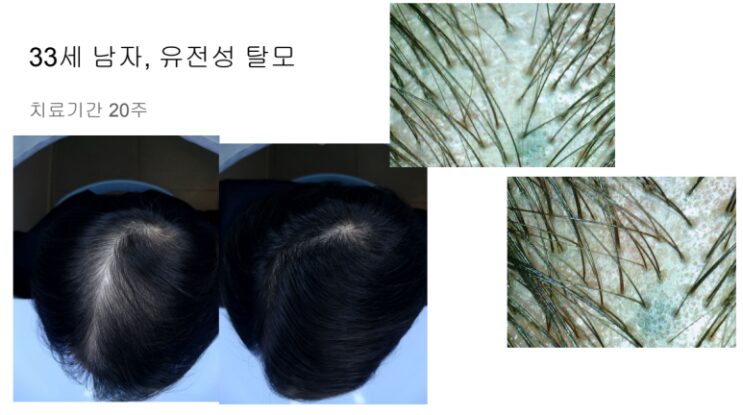
It’s an approach that restores cells and structure at the same time. Many patients feel that their scalp becomes warmer and gains elasticity after the procedure. It also becomes a meaningful option for improving the scalp environment before a hair transplant, or as a second-line treatment for those whose transplant results were disappointing.
Who it’s for — cases where hair loss has progressed considerably / those whose scalp has become cold and thin / those who feel they’ve hit a wall with existing treatment / those who need to improve the scalp environment before or after a hair transplant
③ Follicle injection + scalp-regeneration care
This is a care-oriented treatment for those for whom a procedure still feels daunting. Saeron Clinic’s follicle injection is not simply a nutrient supply. To components that reduce scalp inflammation and improve blood flow around the follicles, we add PDRN (a salmon-DNA ingredient) for an added tissue-regeneration effect.
Even the same follicle injection differs in composition from clinic to clinic. It’s important to check which components are used and at what concentration before choosing. In exchange for a slower onset of effect, recovery is fast and it connects well with repeated care.
Who it’s for — early hair-loss management / those in postpartum or illness recovery for whom an aggressive procedure is difficult
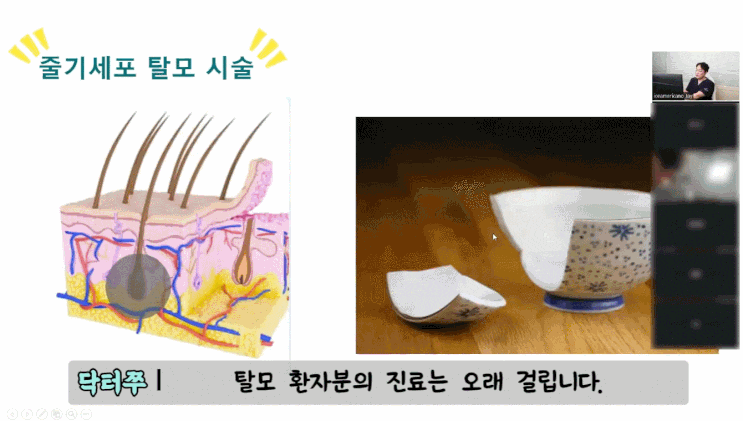
For these patients, the effect is limited
To be honest, scalp stem-cell treatment does not give everyone the same result. The cases I often advise against in the clinic can be summarized as follows.
| Condition | Why the effect is limited | Alternative |
|---|---|---|
| Areas where the follicles have already completely disappeared (NW6–7) | There are no follicles left to restore | Hair transplant + scalp-environment improvement after the procedure |
| Androgenetic hair loss where the patient refuses to take a DHT inhibitor | If the cause keeps acting, the effect is not maintained | Consider combined medication / blocking the cause comes first |
| Active autoimmune alopecia areata | Immune dysfunction is the cause — immune therapy comes first | Re-evaluate after dermatologic immunotherapy |
| Active scalp inflammation or infection | A procedure on an inflamed area carries a risk of side effects | Treat the inflammation → proceed after stabilization |
| Expecting to “recover it all in one go” | It’s not a procedure completed in a single session — it needs care over 3–6 month cycles | A stepwise approach after establishing a long-term plan |
(vs. bone marrow)
effect is assessed
tailored options
What you must know before scalp stem-cell treatment
For stem-cell treatment to produce a meaningful result, two things must always go together.
One, you must block the cause of hair loss with a DHT inhibitor
No matter how well you restore the scalp environment, if DHT keeps attacking the follicles, the effect is not maintained. For androgenetic hair loss, taking finasteride or dutasteride is effectively a precondition. This is why we don’t recommend stem-cell treatment on its own for those who strongly refuse to take medication.
Two, an accurate diagnosis comes first
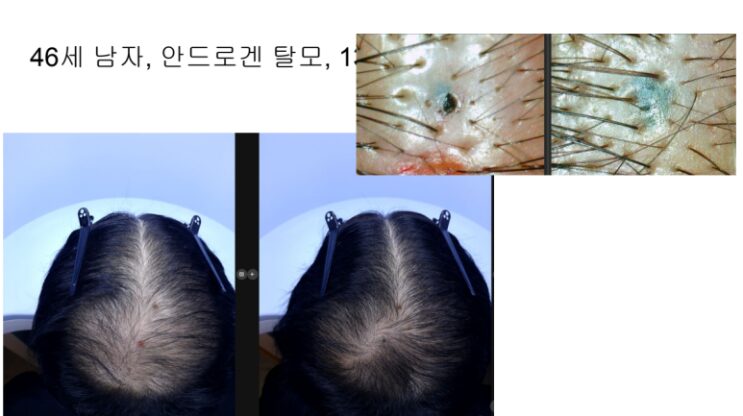
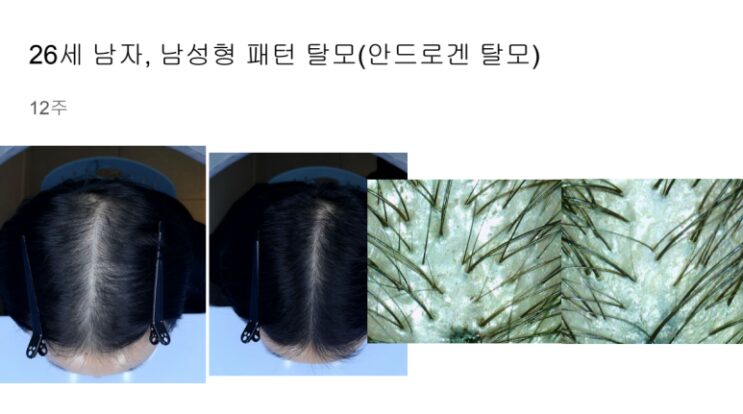
Checking follicle density, scalp inflammation, and fat-layer thickness with magnified imaging (trichoscopy) is what tells us which treatment your scalp needs right now. Treatment doesn’t come first. Knowing the condition of your own scalp first is the starting point.
Rather than a place that simply calls it a “stem-cell injection,” choose a place that explains, based on the diagnostic findings, why this treatment is what you need right now.
Last month a man in his 50s came in saying his hair-transplant results were disappointing. He said that even a year after the transplant, the grafted hair hadn’t thickened and was instead becoming finer.
When we did AFS scalp imaging, the scalp fat layer around the graft site had thinned considerably, and the microvessels were atrophied too — even more than at the graft site itself. It wasn’t a problem of the follicles but of the soil. We first reinforced the scalp environment with SVF + microfat transfer, then combined it with a DHT inhibitor.
Six months later, as the scalp thickness recovered, the grafted hair also began to thicken gradually. This is exactly the role that stem-cell treatment truly plays.