







보건복지부 지정 첨단재생의료 실시기관
Saeron Clinic Magazine Hair Loss & Scalp

Scalp Stem-Cell Treatment for Hair Loss: Who It Helps, Who It Doesn’t (CD34+ PRP · SVF · Microfat)

Hello. I’m Dr. Joo Yong-min, director of Saeron Clinic, and the research lead of an advanced regenerative medicine facility. There are things I hear often in the clinic. “I looked into a hair transplant, but I was turned away because my scalp was in such poor condition.”, “It’s been a few years since my transplant, and the result feels more and more disappointing.”, “I’ve taken medication and had scalp care, but I feel I’ve hit a wall.” Surprisingly, these patients have something in common: the problem wasn’t hair loss itself, but a scalp environment in which the hair follicles couldn’t survive. Today I’ll speak honestly about who scalp stem-cell treatment is a meaningful choice for, and for whom its effect is limited.

Scalp stem-cell treatment is not a procedure that creates new hair follicles. It is a treatment that restores a scalp environment in which the remaining follicles can hold on longer and grow thicker. For that reason, it is meaningful only for those who ① block the cause of hair loss with a DHT inhibitor (finasteride/dutasteride) and ② first check the scalp condition with magnified diagnosis. If the follicles have already completely disappeared, the effect is limited.

Key takeaways
  • Scalp stem-cell treatment is a procedure that restores the scalp environment, not one that creates new hair follicles.
  • In a scalp where hair loss has progressed, microvascular damage, chronic inflammation, and fat-layer atrophy occur at the same time. It’s not a problem of follicle quality but a problem of the soil.
  • Saeron Clinic approaches this in three ways depending on scalp condition and the degree of hair-loss progression: ① blood-derived stem cells (CD34+ PRP) ② adipose-derived stem cells (SVF) + microfat transfer ③ follicle injection + scalp-regeneration care.
  • For the effect to be maintained, scalp stem-cell treatment must always be paired with a DHT inhibitor + magnified diagnosis (trichoscopy).
  • In areas where the follicles have already completely disappeared, the effect is limited, and in such cases a combination with a hair transplant should be considered.
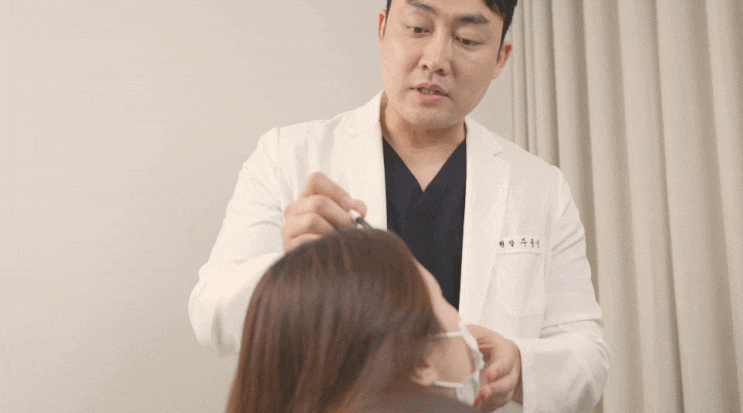
Scalp stem-cell treatment — the consultation room at Saeron Clinic
What the patients turned away from a hair transplant, or disappointed by their results, had in common lay not in the follicles but in the “scalp environment.”

Why is the scalp environment the problem?

In a scalp where hair loss has progressed, three invisible changes occur at the same time.

  • The microvessels around the follicles are damaged, cutting off the nutrient supply.
  • Chronic inflammation gradually wears the follicles down.
  • The scalp’s fat layer thins, so the structural foundation supporting the follicles collapses.

Cases where engraftment after a hair transplant falls short of expectations are often due to this. It’s not a problem of follicle quality but a problem of an environment in which the transplanted follicles can’t take root. This is exactly where scalp stem-cell treatment intervenes.

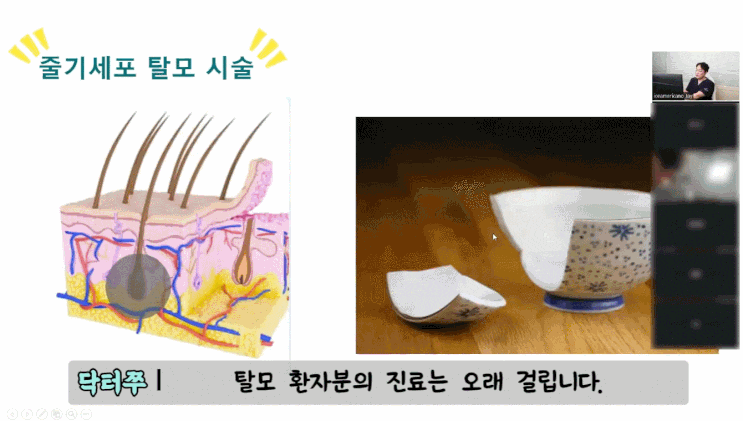
Stem-cell treatment cannot create new follicles. It builds the soil in which the remaining follicles can hold on longer.

Scalp stem cells — Saeron Clinic’s 3 treatment methods

At Saeron Clinic we take three directions depending on the patient’s scalp condition and degree of hair-loss progression. Even under the same name of a “stem-cell injection,” the effect changes completely depending on which components are used, at what concentration, and where.

① Blood-derived stem cells (CD34+ PRP)

When your own blood is concentrated to a high density, CD34+ stem cells are separated out along with platelet growth factors (PDGF, VEGF, IGF, and others). The growth factors send signals directly to the atrophied follicles to induce cell proliferation, and the CD34+ cells form new blood vessels around the follicles to restore blood flow.

This is a method whose effect in improving hair density and thickness has been confirmed through hundreds of international papers. Recovery is fast, with almost no disruption to daily life. However, when hair loss has progressed considerably, its effect on its own may be limited.

Who it’s for — those in their 20s–40s with early hair loss, sudden postpartum hair loss, or those who want to start simply
CD34+ PRP blood-derived stem-cell scalp procedure
CD34+ PRP — growth factors and stem cells are concentrated from your own blood and injected directly around the follicles.

② Adipose-derived stem cells (SVF) + microfat transfer

SVF extracted from fat tissue contains 100–1,000 times more mesenchymal stem cells than bone marrow. It suppresses scalp inflammation, regenerates damaged vessels, and restores atrophied tissue.

At Saeron Clinic we add microfat transfer to this. In a scalp where hair loss has progressed, the fat layer itself has thinned. No matter how good the cells you inject, if there’s no soil to take root in, the effect is limited. Reinforcing the scalp’s fat layer with microfat transfer creates a structural environment in which the follicles can be supported.
SVF adipose-derived stem cells + microfat transfer
SVF + microfat transfer — an approach that restores cells and structure at the same time.

It’s an approach that restores cells and structure at the same time. Many patients feel that their scalp becomes warmer and gains elasticity after the procedure. It also becomes a meaningful option for improving the scalp environment before a hair transplant, or as a second-line treatment for those whose transplant results were disappointing.

Who it’s for — cases where hair loss has progressed considerably / those whose scalp has become cold and thin / those who feel they’ve hit a wall with existing treatment / those who need to improve the scalp environment before or after a hair transplant

③ Follicle injection + scalp-regeneration care

This is a care-oriented treatment for those for whom a procedure still feels daunting. Saeron Clinic’s follicle injection is not simply a nutrient supply. To components that reduce scalp inflammation and improve blood flow around the follicles, we add PDRN (a salmon-DNA ingredient) for an added tissue-regeneration effect.

Even the same follicle injection differs in composition from clinic to clinic. It’s important to check which components are used and at what concentration before choosing. In exchange for a slower onset of effect, recovery is fast and it connects well with repeated care.

Who it’s for — early hair-loss management / those in postpartum or illness recovery for whom an aggressive procedure is difficult
Follicle injection + scalp-regeneration care
Follicle injections differ in their component makeup from clinic to clinic. Even under the same name, if the drugs that go in differ, the effect differs too.

For these patients, the effect is limited

To be honest, scalp stem-cell treatment does not give everyone the same result. The cases I often advise against in the clinic can be summarized as follows.

ConditionWhy the effect is limitedAlternative
Areas where the follicles have already completely disappeared (NW6–7)There are no follicles left to restoreHair transplant + scalp-environment improvement after the procedure
Androgenetic hair loss where the patient refuses to take a DHT inhibitorIf the cause keeps acting, the effect is not maintainedConsider combined medication / blocking the cause comes first
Active autoimmune alopecia areataImmune dysfunction is the cause — immune therapy comes firstRe-evaluate after dermatologic immunotherapy
Active scalp inflammation or infectionA procedure on an inflamed area carries a risk of side effectsTreat the inflammation → proceed after stabilization
Expecting to “recover it all in one go”It’s not a procedure completed in a single session — it needs care over 3–6 month cyclesA stepwise approach after establishing a long-term plan
Quote-ready · the essence of scalp stem-cell treatment Stem-cell treatment is not a procedure that creates new follicles, but a treatment that restores a scalp environment in which the remaining follicles can hold on longer and grow thicker.
Must 1Block the cause of hair loss with a DHT inhibitor (finasteride/dutasteride) — restoring the environment alone cannot stop the progression.
Must 2Check follicle density, scalp inflammation, and fat-layer thickness with magnified imaging (trichoscopy) — we don’t start treatment without a diagnosis.
LimitIn NW6–7 areas where the follicles have completely disappeared, the effect is limited, and we consider a combination with a hair transplant.
100~1000×SVF stem-cell concentration
(vs. bone marrow)
3~6 monthspoint at which treatment
effect is assessed
3 optionsSaeron Clinic scalp stem-cell
tailored options

What you must know before scalp stem-cell treatment

For stem-cell treatment to produce a meaningful result, two things must always go together.

One, you must block the cause of hair loss with a DHT inhibitor

No matter how well you restore the scalp environment, if DHT keeps attacking the follicles, the effect is not maintained. For androgenetic hair loss, taking finasteride or dutasteride is effectively a precondition. This is why we don’t recommend stem-cell treatment on its own for those who strongly refuse to take medication.

Two, an accurate diagnosis comes first

Checking follicle density, scalp inflammation, and fat-layer thickness with magnified imaging (trichoscopy) is what tells us which treatment your scalp needs right now. Treatment doesn’t come first. Knowing the condition of your own scalp first is the starting point.

Rather than a place that simply calls it a “stem-cell injection,” choose a place that explains, based on the diagnostic findings, why this treatment is what you need right now.
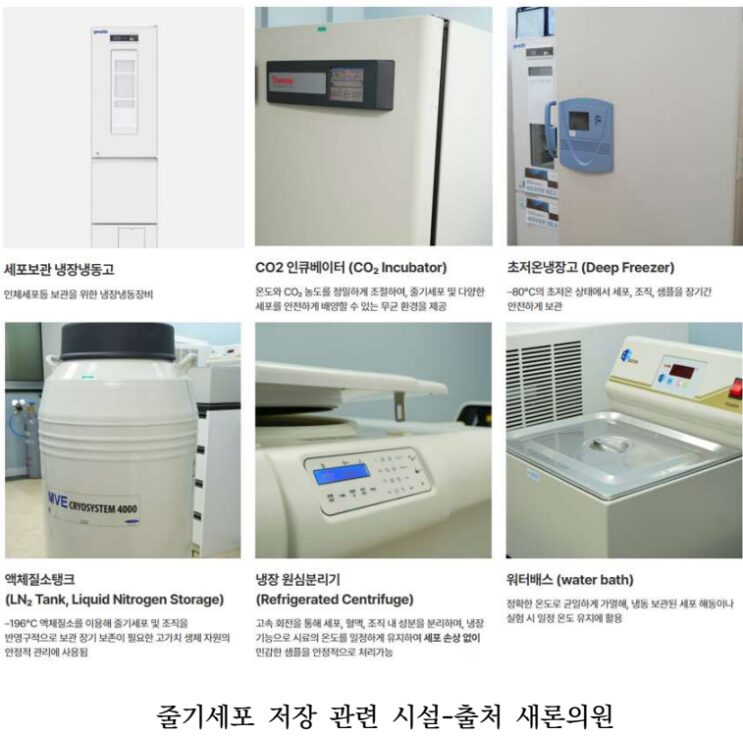
Saeron Clinic stem-cell storage facility — cell-storage refrigerators, liquid-nitrogen tanks, CO2 incubators
Stem-cell procedures require cell storage and culture facilities. This is an environment that only a Ministry of Health and Welfare–designated advanced regenerative medicine facility can maintain.
A scene from the clinic

Last month a man in his 50s came in saying his hair-transplant results were disappointing. He said that even a year after the transplant, the grafted hair hadn’t thickened and was instead becoming finer.

When we did AFS scalp imaging, the scalp fat layer around the graft site had thinned considerably, and the microvessels were atrophied too — even more than at the graft site itself. It wasn’t a problem of the follicles but of the soil. We first reinforced the scalp environment with SVF + microfat transfer, then combined it with a DHT inhibitor.

Six months later, as the scalp thickness recovered, the grafted hair also began to thicken gradually. This is exactly the role that stem-cell treatment truly plays.
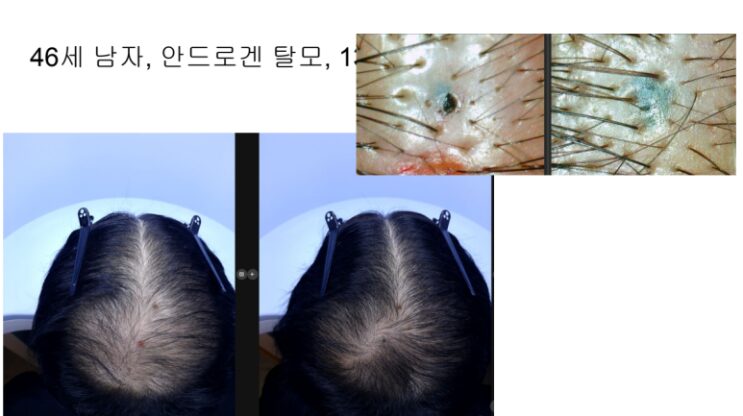
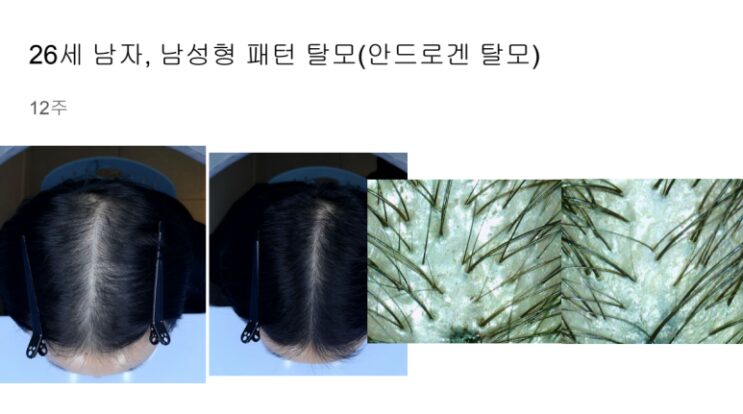
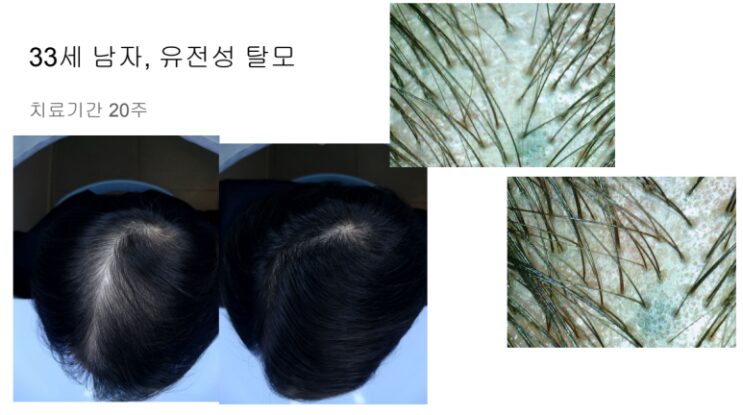
Scalp photos before and after stem-cell treatment — the process of recovering follicle density
The process in which scalp thickness recovers and the follicle environment improves after SVF + microfat transfer.
Self-checklist before scalp stem-cell treatment
Preconditions
Choosing a clinic
Aligning expectations
Frequently asked questions
Does scalp stem-cell treatment grow new hair?
Strictly speaking, it is not a procedure that creates new follicles. What stem-cell treatment restores is the scalp environment — the microvessels, the inflammatory state, and the fat-layer structure. As a result, changes are observed in which follicles that had been in the resting phase re-enter the growth phase, or hair that had thinned thickens again. That said, I want to make it clear that this is not a procedure in which new hair springs from completely disappeared follicles.
Between a hair transplant and scalp stem cells, which should I get first?
It depends on the scalp condition. If the scalp is cold and thin, improving the environment first with stem-cell treatment and then transplanting raises the engraftment rate. Conversely, for those whose transplant results didn’t come out as expected, we consider SVF as a second-line treatment. At Saeron Clinic, we decide the order after magnified diagnosis, looking at scalp thickness and vascular condition.
Do I really have to take a DHT inhibitor (medication) along with it?
For androgenetic hair loss (AGA), it is effectively a precondition. No matter how well you restore the scalp environment, if the DHT hormone keeps attacking the follicles, the effect is not maintained. For those who strongly refuse to take medication, we don’t recommend stem-cell treatment on its own. I believe it is the medical team’s responsibility to be just as honest about who is not a candidate.
They’re all called the same stem-cell injection — so why do price and effect differ from clinic to clinic?
That’s an accurate question. Even if the name “stem-cell injection” is the same, if these five things differ, the result changes completely: ① the type of cells (PRP / SVF / BMAC) ② the cell concentration ③ the separation and purification equipment ④ the compounded components (whether adjuncts such as PDRN are present) ⑤ the site and depth of the procedure. At the consultation, be sure to ask, “Which cells, at what concentration, and where are they injected?”
Key terms
CD34+ PRP (blood-derived stem cells)
Def.A procedure that concentrates your own blood to separate CD34-positive stem cells together with platelet growth factors. It induces new blood-vessel formation and cell-proliferation signals around the follicles.
PlainThink of it as a “concentrate of recovery signals” drawn from your own blood.
DHT (dihydrotestosterone)
Def.A potent androgen converted from testosterone by 5α-reductase. It atrophies genetically sensitive follicles, causing androgenetic hair loss.
Plain“The real culprit hormone behind AGA hair loss” — finasteride and dutasteride block this hormone.
Trichoscopy (magnified scalp diagnosis)
Def.A non-invasive diagnostic method that observes the scalp, follicles, and hair shafts under high-magnification. It can quantitatively assess follicle density, miniaturization, inflammation, and the state of the fat layer.
Plain“An examination that looks at your scalp under a microscope” — the starting point of any treatment decision.
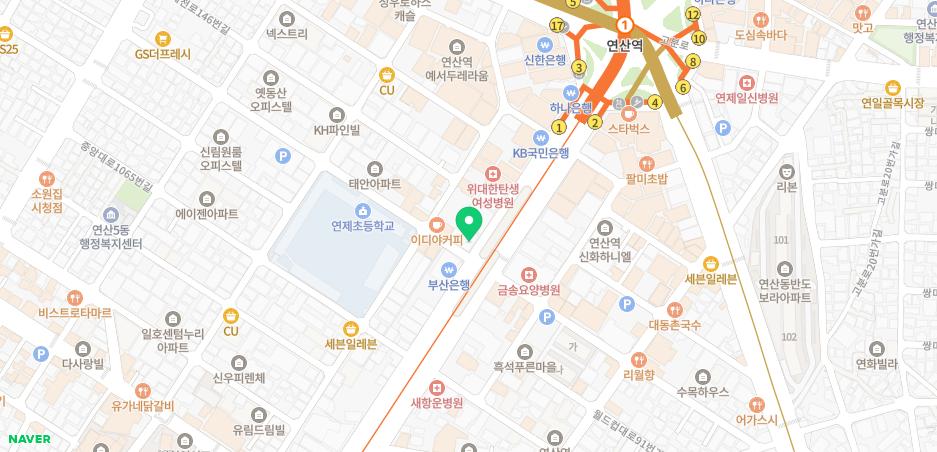
Saeron Clinic location — near Yeonsan Station, Yeonje-gu, Busan
Saeron Clinic — 5F Sanggye Building, 1077 Jungang-daero, Yeonje-gu, Busan (near Yeonsan Station, a 5-minute walk).
This post is medical advertising written by the clinic to provide medical information, and complies with Article 56(1) of the Korean Medical Service Act. Effects may vary with individual constitution and health status, so please decide on treatment after a thorough consultation with a medical professional.

At Saeron Clinic, the director (Dr. Joo Yong-min) personally handles everything from consultation to treatment, procedure, and aftercare, and the clinic runs by 100% appointment only to provide individually tailored care for each patient. The number of patients seen per day is limited, so we ask for your understanding.

Directions — Saeron Clinic · 5F Sanggye Building, 1077 Jungang-daero, Yeonje-gu, Busan · 051-710-1616
THE SAERON STORY

Dr. Yong-min Joo · Emergency Medicine Specialist

With over 15 years on the frontlines of emergency medicine and approximately 150,000 patients treated, Dr. Joo focuses exclusively on stem cell and regenerative medicine. As a Ministry of Health & Welfare–designated institution, he personally oversees every step from diagnosis to treatment and aftercare.

15+yrs in Emergency Med.
150K+patients treated
100%appointment only