







What does NAD+ do inside the cell?
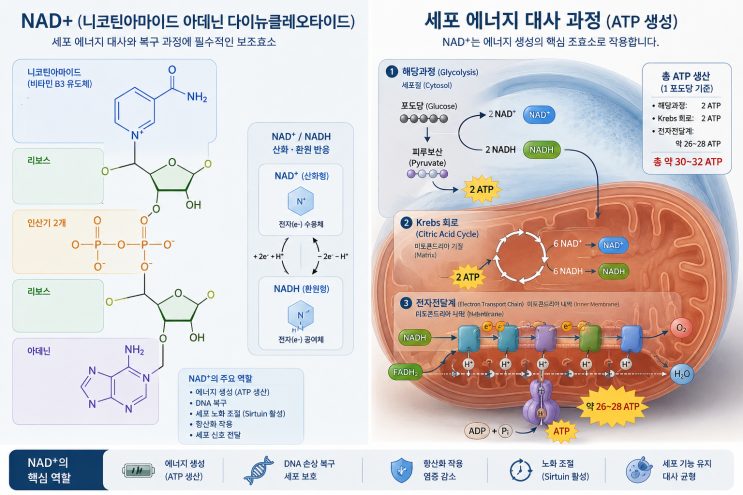
NAD+ does three things inside the cell. First, it serves as a key coenzyme when mitochondria make ATP. A shortage brings chronic fatigue and reduced muscle strength. Second, it is consumed when the PARP enzyme repairs damaged DNA. When it runs short, aging accelerates and cell function declines. Third, it acts as the switch that turns on the sirtuin enzymes — the so-called longevity genes.
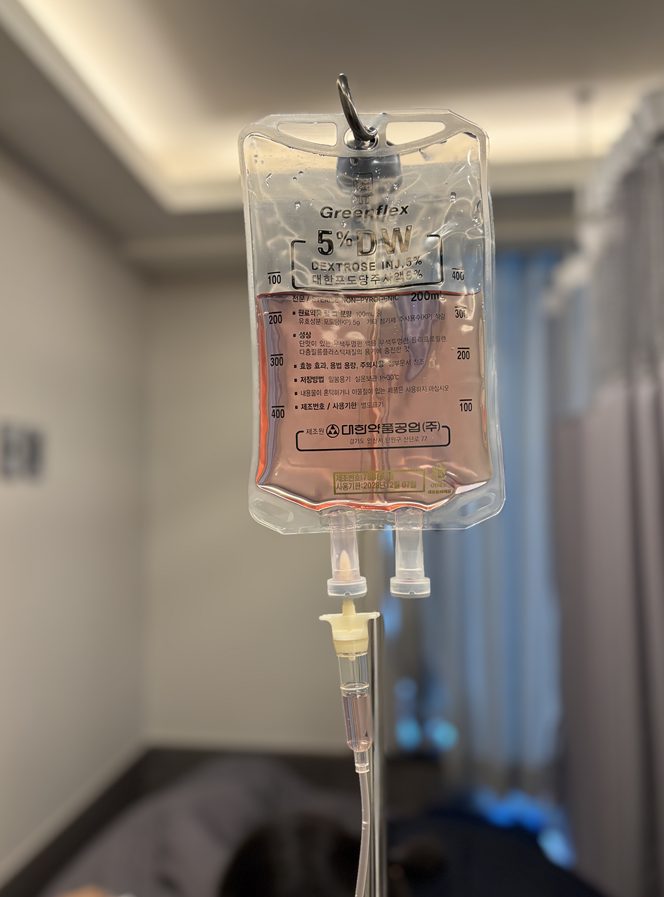
The third point in particular is why Harvard’s Professor David Sinclair calls NAD+ the master key of aging research (Imai & Guarente, Trends in Cell Biology, 2014). Sirtuins are the cell’s managers that tidy up DNA, calm inflammation, and direct mitochondrial cleanup — and to get these managers to show up for work, you need an access card called NAD+.
The NAD+ in our body peaks in our 20s and drops a little each year, falling to about half by our 50s (Massudi et al., PLOS ONE, 2012). By analogy, the cell is a factory and NAD+ is the electricity that runs it. In your 20s there’s plenty of power and every line runs, but by your 50s outages become frequent and some lines stop. That’s the drop in stamina and delayed recovery we feel.
If it’s given intravenously, does it get inside the cell?
To put the conclusion first, the NAD+ molecule is too large to pass directly through the cell membrane. The marketing line that it is delivered straight into the cell when given by IV is not pharmacokinetically accurate. A 2026 systematic review also concluded that the claim that NAD+ given intravenously, intramuscularly, or subcutaneously enters cells as an intact molecule and directly fills the intracellular NAD+ pool is not supported by current evidence.
That doesn’t mean there’s no effect at all, either. What actually happens follows this sequence. Within the bloodstream, NAD+ is broken down by enzymes such as CD38 into smaller fragments, split into raw-material parts like niacinamide, NMN, and NR. These parts enter the cell and are reassembled into NAD+, and the intracellular concentration gradually rises over hours to days.
An NAD+ drip is less about delivering NAD+ to the cell, and more about generously supplying the raw materials for the cell to remake NAD+.
And these materials can also be supplied by oral medication. Prescription niacin injections available in Korea work on the same principle, at an incomparably lower cost. An intravenous drip raises the blood concentration sharply for a faster felt effect, but comes with the burden of cost and side effects such as facial flushing and nausea. Oral NR or NMN has abundant data on convenience and safety, but the rise in blood concentration is gradual.
There’s another important fact. Even with the same NAD+ drip, the response varies from person to person. If the CD38 enzyme is too active, the incoming NAD+ is broken down quickly, and if chronic inflammation is severe, the NAD+ that is made is rapidly consumed by the PARP enzyme (Covarrubias et al., Nature Reviews Molecular Cell Biology, 2021). Without first managing chronic inflammation, it becomes like pouring water into a leaky jar.
Who benefits from it?
If we honestly acknowledge its position as an expensive treatment with only partially proven efficacy, one question remains: for whom is it meaningful, and for whom is the benefit low?
Someone who reports severe chronic fatigue with no major abnormality on testing yet still doesn’t recover may want to consider the possibility of reduced mitochondrial function. Using it as part of an integrated anti-aging program in those over 50 also has meaning in that it replenishes the natural decline. For short-term recovery after long-haul flights, jet lag, or overwork, there are many reports of a felt benefit. For those with a family history of neurodegenerative disease, a preventive approach is still in clinical trials, so I regard it as supportive at most.
On the other hand, I don’t recommend it for people in their 20s and 30s who simply want to look younger. Many people see 20-something celebrities getting it on social media and want to get a head start, but the 20s are when NAD+ is most abundant. Rather than paying a lot to supply it from outside, you get the same effect for free just by keeping up sleep, exercise, and moderation in drinking.

There are also clear cases to avoid or approach with caution. During pregnancy and breastfeeding, safety data are lacking. With severe liver or kidney impairment, the burden on metabolism and excretion increases. During active cancer treatment I don’t recommend it, since NAD+ may also support the metabolism of some cancer cells. Anyone who has had a cardiovascular event within the past 3 months must consider the burden from vasodilation, and in those with severe gout or hyperuricemia, elevated uric acid has been reported with niacin-class agents.
Why does it take a whole hour?
The most common side effects are facial flushing, chest tightness, nausea, and a sense of heat in the head and limbs. The intensity of these symptoms is directly proportional to the infusion rate. If it’s too fast, the blood concentration surges sharply and vasodilation happens all at once, producing hard-to-bear flushing and palpitations.
That’s why the clinical standard is to drip it slowly over about an hour, adjusting the rate according to age, weight, constitution, and any history of past side effects. For a first-time patient, the safe approach is to go more slowly on the first session and, over repeated sessions, find the rate you can tolerate.
I received it myself several times before recommending it to patients. To be honest, I felt it all — the flushing, the nausea, and the heat washing from head to toe. At first I even wondered whether this was normal, but the next day my condition was clearly lighter. So I now confidently explain that this feeling isn’t dangerous but a sign that metabolism is being activated. That said, if it’s too severe, please don’t tough it out — be sure to tell us.
Beyond fuel, to the engine
Adding NAD+ is, in the end, about replenishing the fuel the cell needs to work. That’s a good thing, but no matter how much fuel you add, if the engine itself is worn out, there’s a limit to the output.
Regenerative medicine asks a different question here: can the engine itself — that is, the cell itself — be replaced with a new one? Approaches using stem cells and growth factors are the road toward that answer. An IV drip is the starting point of that journey, not the destination.