







보건복지부 지정 첨단재생의료 실시기관
Saeron Clinic Magazine Hair Loss & Scalp

Telogen Effluvium: Why Hair Suddenly Falls Out and What to Check

Hello. I’m Dr. Joo Yong-min, director of Saeron Clinic, a designated advanced regenerative medicine facility. Two questions come up in my consultation room again and again: “My hair has suddenly started falling out in clumps. Am I going to lose all of it?” and “I’m on hair-loss medication and it’s still falling out. Has the medication stopped working?” Watching a handful of hair come away in the brush is frightening, and it’s natural to assume the worst. So I’ll be honest with you about two things here: how to tell whether a sudden increase in shedding is telogen effluvium, and what you should check before you change any medication.

Telogen effluvium is hair shedding that follows a shock such as a high fever or serious illness, childbirth, crash dieting, or severe stress. Growing-phase follicles shift into the resting phase all at once, and usually 2 to 3 months later more than 100 hairs a day fall out evenly across the whole scalp. Unlike genetic hair loss, where follicles shrink, the follicles here are only resting, so hair often recovers once the cause is found and corrected. That is why the right order is to trace the timing and run basic blood tests before changing medication.

Key takeaways

  1. Telogen effluvium starts with a lag of about 2 to 3 months after a shock. The reason your hair is falling out now often lies two or three months back.
  2. In genetic hair loss the factory shrinks; in telogen effluvium the factory just pauses. The two can arrive together, so they need to be told apart.
  3. Basic blood tests such as ferritin, thyroid function, vitamin D, and zinc come first to find hidden causes, and the treatment plan follows from there.

What is telogen effluvium?

Telogen effluvium is a condition in which follicles in the growth phase move into the resting phase earlier than scheduled and all at the same time, so that more than 100 hairs a day fall out evenly across the whole scalp.

Hair has a working period and a resting period. After a growth phase (anagen) of 2 to 6 years, a hair enters a resting phase (telogen) of a few weeks, and the resting hair then falls out and is replaced by a new one. Normally each follicle runs on its own clock, so only about 10% of hairs are resting at any one time and they shed a little at a time, without anyone noticing.

The trouble starts when the body takes a major hit. The scattered clocks get reset to resting time together, and the share of resting hairs has been reported to rise to 20% to 30% (Malkud S, J Clin Diagn Res, 2015). A review of telogen effluvium describes the same mechanism (Rebora A, Clin Cosmet Investig Dermatol, 2019).

In telogen effluvium the follicles aren’t damaged. They are all taking a break at the same time.

Woman in a bathroom frowning at her reflection while holding a wooden hairbrush with loose hair caught in the bristles
If a single brushing pulls out a handful, look back two or three months.

How is acute telogen effluvium different from chronic?

Acute telogen effluvium has a clear trigger and begins some time after it. Common triggers include childbirth, crash dieting and nutritional deficiency, emotional shocks such as bereavement, major illnesses with a high fever such as influenza or pneumonia, surgery, and changes in medication. The shedding usually starts not right after the shock but 2 to 3 months later, all at once (Hughes EC, Saleh D, StatPearls, 2024).

That lag is what confuses so many patients. They ask, “Things are fine now, so why is it falling out now?” If you ran a high fever with the flu in winter, it may show up as shedding in spring. So the first thing I ask is whether you were seriously ill at any point in the past few months.

2-3 mothe lag between a shock and the start of shedding (Hughes, Saleh, StatPearls 2024)
~30%Korean women with hair loss reported to have iron deficiency or low ferritin (Park SY et al., J Korean Med Sci 2013)
6-9 mothe typical time to recover close to the previous state after the cause is corrected

Chronic telogen effluvium is shedding of more than 100 hairs a day that continues for 6 months or longer without a clear trigger. The trigger is hard to pin down, and researchers are still debating whether it should be considered a distinct condition (Daunton A et al., Am J Clin Dermatol, 2023). I’ll be straight with you: with the chronic form, I can’t always give a neat explanation for every cause. We use basic tests to rule out other causes one by one.

In the clinic

Quite a few patients mention a hard time from a few months back only well into the consultation. They thought it was behind them, but their hair only reacted three months later. That’s why, before I look at the scalp, I go back through the calendar for the previous two or three months with them.

How is it different from genetic hair loss?

It helps to think of each follicle as a small hair factory. Genetic hair loss is the factory itself gradually getting smaller. The follicle shrinks in response to a hormone called DHT, and the hairs it produces become thinner and shorter. This is called miniaturization, and it is the core of genetic hair loss (Sinclair R, BMJ, 1998). Telogen effluvium, by contrast, is the factory staying the same size but closing its doors for a while, all at once. Once the cause is resolved, production often restarts and hairs of similar thickness grow back.

The pattern of loss gives clues too. Genetic hair loss thins mainly at the front hairline and the crown over several years without a clear trigger. Telogen effluvium falls out suddenly and evenly across the whole head after a trigger, and hair thickness is generally maintained. If thinning at the crown progresses slowly, I suspect genetic hair loss first; if hair comes out in coin-shaped patches, I suspect alopecia areata first.

The catch is that the two can overlap. One study found female pattern hair loss in a substantial share of women who had acute telogen effluvium (Perez-Mora N et al., Dermatol Ther, 2014). In practice I often see genetic hair loss that had been hidden come to the surface, or speed up, during this period.

Quote-ready unitGenetic hair loss is follicles shrinking; telogen effluvium is follicles resting for a while. The causes differ, so the treatment approach differs too.

WhyGenetic hair loss is follicle miniaturization driven by DHT, while telogen effluvium is growth-phase follicles resting all at once after a shock.
ExampleIf you take hair-loss medication consistently and still suddenly shed a lot, it may not be that the medication has failed. Telogen effluvium may have started alongside it.
CautionThe two can overlap and can also be confused with alopecia areata, so self-diagnosis alone is not enough to confirm which one you have.

What do basic blood tests check for hair shedding?

Diagnosing telogen effluvium relies more on tracing the timing and blood tests than on imaging. In my clinic we look at three things together: a timeline that pins down events from two or three months earlier, a scalp magnifier that shows how hair thickness is distributed, and blood tests that look for hidden causes.
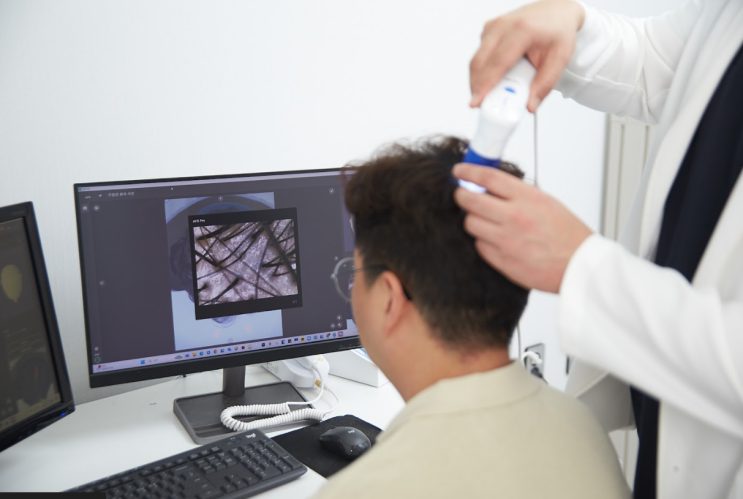
Clinician in a white coat holding a handheld scalp camera to a seated patient's crown while a monitor shows a magnified image of scalp and hair strands
A scalp magnifier shows whether hair thickness is even, or whether only the crown is thinning.

The basic blood panel mainly checks ferritin, which shows iron stores; a complete blood count (CBC) for anemia; thyroid function (TSH, free T4); vitamin D and vitamin B12; and zinc. A study comparing 100 women with hair loss and 100 healthy women found clear differences in several markers, including ferritin, TSH, vitamin B12, and vitamin D. Mean ferritin was 39.34 ng/mL in the hair-loss group and 48.09 ng/mL in the control group (Al-Fawaeir S, Al-Odat I, Diseases, 2025).

Ferritin is often not included automatically in a routine blood test. Even if you were told “your blood work was normal,” if ferritin wasn’t on the list, there is still ground nobody has looked at. That said, I don’t treat one low number as the sole cause. I weigh several markers together.

What should you check before changing hair-loss medication?

The short answer: before you switch medication, shampoo, or supplements, find out why your hair is falling out. That is the fastest route. Drugs that block DHT are the mainstay of treatment for genetic hair loss, but telogen effluvium is not shedding those drugs alone can stop. And the reverse holds: if genetic hair loss is also present but you treat it purely as telogen effluvium and wait, miniaturization can progress further in the meantime.

Managing acute telogen effluvium combines correcting the cause with giving it time. That means replacing nutrients that are deficient, protecting your sleep, and reviewing the medications you take. Follicles need time to return to the growth phase, so it usually takes several months before visible change.

For the chronic form, evidence for regenerative treatment is building. In a randomized controlled pilot trial of 30 women with chronic telogen effluvium, PRP injected into the scalp monthly was followed at 3 months by reduced shedding and improved hair density and thickness, with no serious adverse events (Ezz El-Dawla R et al., Indian J Dermatol Venereol Leprol, 2023). A meta-analysis pooling 21 studies also found a trend toward improvement (Yuan J et al., Skin Res Technol, 2024). Still, this is pilot-stage research, data on how long the effect lasts are limited, and some people relapse after recovering.

When your hair suddenly starts falling out: what to check, in order

1. Look back at the timing
2. Look at the shedding pattern
3. Testing and care
Frequently asked questions

How long does it take to recover from telogen effluvium?
The shedding phase itself usually lasts about 2 to 4 months, and once the cause is corrected, many people recover close to their previous state within 6 to 9 months. Recovery can be slower if there is a genetic predisposition or the cause is still present.
Is heavy hair loss after childbirth telogen effluvium?
Yes. Postpartum hair loss is a classic form of telogen effluvium. Hair held in place by pregnancy hormones enters the resting phase all at once 2 to 4 months after delivery, and most women recover within 12 months. If recovery is slow, I recommend seeing a doctor.
I’m on hair-loss medication and still shedding. Has it stopped working?
Rather than assuming the drug has failed, I first consider whether genetic hair loss and telogen effluvium are happening together. Hair-loss medication targets genetic hair loss, so it can’t stop telogen shedding. We start with events from the past two or three months and blood tests.
If my blood tests are normal, does that mean there is no cause?
No. Deficiencies found on blood tests are only some of the possible causes. Check whether ferritin was included, and even with normal values we look at other factors such as stress and scalp condition.
Will taking supplements be enough to fix it?
If you are short of a nutrient, supplements can help, but ferritin, vitamin D, and zinc are worth supplementing only when a deficiency has been confirmed. Adding more supplements without testing is not very efficient.
Key terms
Telogen effluvium
Def.Hair loss in which growth-phase follicles shift into the resting phase all at once after a shock, causing even shedding across the whole scalp 2 to 3 months later.
PlainYour hair factories all taking a break at the same time.
Anagen and telogen
Def.Hair cycles between a growth phase lasting 2 to 6 years and a resting phase of a few weeks; resting hairs fall out and are replaced by new ones.
PlainHair has working hours and rest hours too.
Ferritin
Def.A blood marker showing how much iron the body has stored; it is often not included automatically in a routine blood test.
PlainThe stock level in your iron warehouse.
Trichoscopy (scalp magnifier exam)
Def.An exam that magnifies the scalp and hair to assess the distribution of hair thickness and follicle condition, used to tell types of hair loss apart.
PlainA magnifying glass that shows whether hair is resting evenly or only the crown is shrinking.

This post is medical advertising intended to provide medical information and complies with Article 56(1) of the Korean Medical Service Act. Effects and side effects may vary with individual constitution and health status, so please decide on treatment after a thorough consultation with a medical professional.

THE SAERON STORY

Dr. Yong-min Joo · Emergency Medicine Specialist

With over 15 years on the frontlines of emergency medicine and approximately 150,000 patients treated, Dr. Joo focuses exclusively on stem cell and regenerative medicine. As a Ministry of Health & Welfare–designated institution, he personally oversees every step from diagnosis to treatment and aftercare.

15+yrs in Emergency Med.
150K+patients treated
100%appointment only