






What does hair loss stem cell treatment actually do?
Hair loss stem cell treatment isn’t the name of a single procedure. It is an umbrella term for regenerative treatments that apply stem cells, tissue containing them, or substances made by cells to the scalp.
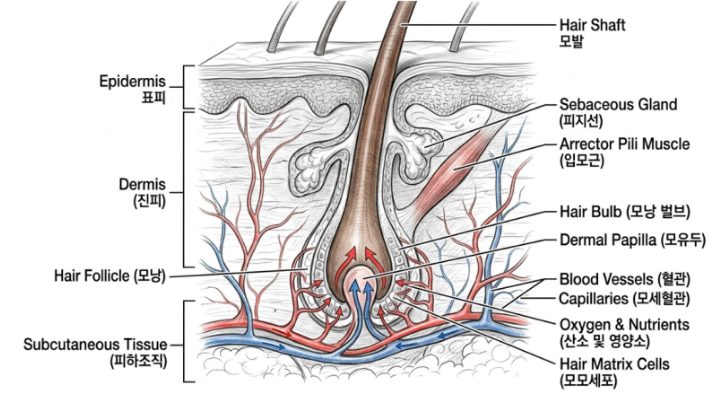
It’s easy to assume that a bald spot is where the roots have died. But a study in the Journal of Clinical Investigation (Garza LA et al., 2011) reported that a substantial share of hair follicle stem cells remains even in scalp affected by advanced male pattern hair loss, and that what had decreased was their conversion into the precursor cells that make hair.
The problem in a balding scalp isn’t that stem cells are missing; it’s that they can’t wake up.
To put it another way, a follicle is a seed still lying in the ground, and the scalp is the soil it’s buried in. Regenerative treatment is closer to channeling water back into dry soil. The injected cells don’t simply turn into new hairs; the explanation is that the growth factors and signaling molecules they release stimulate blood vessel formation and hair growth signals such as Wnt (Gentile P, Garcovich S, Cells, 2019).
Why do the follicles need to still be there?
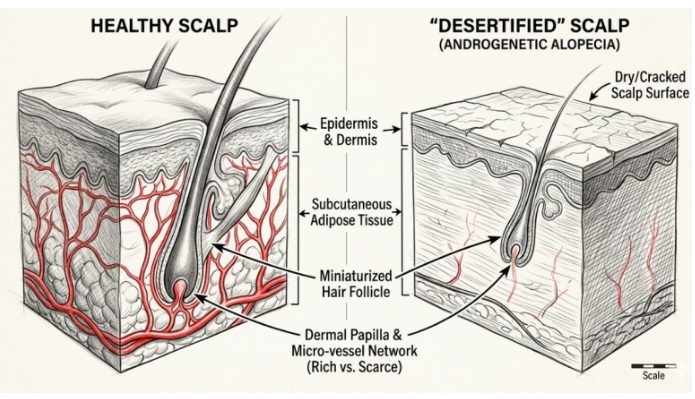
In male pattern hair loss, the influence of dihydrotestosterone (DHT) slows the conversion into growth-phase cells, and the follicles gradually shrink, a process called miniaturization. It is a progressive condition in which genetics and hormonal sensitivity act together (Lolli F et al., Endocrine, 2017).
What regenerative treatment targets is exactly these follicles that have thinned but are still alive. The longer a follicle stays dormant, the less room there is to turn it around. Regenerative treatment aims to improve the function of follicles that remain; it has not been proven to create new follicles where they have already been lost.
The same holds for medication response. In a two-year clinical trial of finasteride (Kaufman KD et al., J Am Acad Dermatol, 1998), improvement on photographic assessment was seen in 66%, compared with 7% in the placebo group. At the same time, about 1 in 3 showed no visible improvement even after two years. This is called a poor response to medication.
Typical causes include deep miniaturization, reduced scalp blood flow or chronic inflammation, irregular use of the medication, and other causes mixed in, such as telogen effluvium or thyroid problems. More often than the type of drug, the bigger variable is the condition the remaining follicles are in.
Some people come in saying, “I took the medication for two years and nothing changed.” When I look with a scalp magnifier, it’s quite common to find that the follicles themselves are still there but the hairs have thinned to something like fine vellus hair. For these patients, looking at the environment around the follicles as well, rather than switching medications, has proved worthwhile.

Who is not a candidate?
To be honest, there are clearly people it doesn’t suit. In long-standing smooth, shiny areas where almost no follicles remain, or where follicles have been lost to scarring, the response one can expect is limited, so hair transplantation is considered first.
Sudden hair loss of unknown cause calls for testing to find the cause first, and active scalp inflammation or infection calls for treating the inflammation first. For alopecia areata, an autoimmune condition, and for telogen effluvium after childbirth or a thyroid problem, treating the cause also comes first. If you have a bleeding risk or take anticoagulants, suitability is checked separately.
If you haven’t given standard medication a fair trial, that comes first.
How far has the evidence come?
First, you need to distinguish what is actually being injected. Autologous fat and SVF contain cells; PRP, conditioned media and exosomes use growth factors or signaling molecules without cells. When I ask people who say they’ve had a stem cell injection, it quite often turns out to have been PRP or a conditioned medium.
In Korea, conditioned media and exosomes are cosmetic ingredients, not medicines. The Ministry of Health and Welfare has stated its position that a medical institution injecting a product that is not a medicine may violate medical laws and regulations (Ministry of Health and Welfare, 2024).
In a randomized, placebo-controlled study in which PRP was injected into one half of the scalp and a sham injection into the other (Gentile P et al., Stem Cells Transl Med, 2015), hair density on the PRP side rose by an average of 45.9 hairs per cm² after 3 months. However, 4 of the 20 men showed clearly renewed shedding about 16 months after the last session and received further treatment.
In a randomized, double-blind study of 38 people who applied an adipose stem cell extract for 16 weeks (Tak YJ et al., Stem Cells Transl Med, 2020), the change in hair count was 28.1%, higher than the 7.1% in the control group. This was, however, a study of an extract, not of cells. Autologous fat grafting with added SVF (Perez-Meza D et al., Stem Cells Cloning, 2017) reported an average increase of 31 hairs per cm² after 24 weeks, but it was an early case study without a control group.
A systematic review pooling 15 studies and 653 patients (Krefft-Trzciniecka K et al., Cells, 2023) summarized increases in density and an absence of major side effects, while urging cautious interpretation. The European guideline for hair loss treatment (Kanti V et al., J Eur Acad Dermatol Venereol, 2018) recommends oral finasteride and topical minoxidil as first-line treatment for male pattern hair loss, and judged that the evidence for regenerative treatments such as PRP is not yet sufficient.
Saying the evidence is still building doesn’t mean it doesn’t work; it means it hasn’t yet earned a place as standard treatment.
How does it work alongside medication?
Hair loss stem cell treatment is not a replacement for medication but an option added on top of it. In male pattern hair loss the hormonal signal keeps running, so I don’t recommend dropping standard treatment just because you’ve started regenerative treatment. In female pattern hair loss, too, topical minoxidil is the first-line treatment.
The order is: first, diagnose the type and the follicles; second, stay on medication; third, add regenerative treatment if the response plateaus; fourth, compare photos and density under the same conditions every 3 to 6 months. Reverse that order and the picture gets muddied.
Hair has a long growth cycle, so wait at least 3 to 4 months, and assessment usually takes place around the 6-month mark. Responses to the same treatment vary from person to person, and some people see little change. Pain at the injection site and temporary swelling are common.
Most of these treatments are not covered by national health insurance and costs vary by clinic, so ask about the cost of the whole plan. I spent 18 years working in emergency rooms, and there I learned how harmful unnecessary treatment can be. That’s why I only recommend treatments I would recommend to my own family.