







What is checked at the first visit?
Hair loss care is not about counting the hairs that have fallen out; it is the process of identifying the type of hair loss and the state of the remaining follicles. The same worry, “my hair is falling out,” calls for completely different treatment when the cause is different. The type is determined, and a treatment plan made, through a medical interview, a magnified scalp exam and, when needed, blood tests, and the magnified scalp exam sits at the center of it.
Trichoscopy is an exam that magnifies the scalp and hair dozens of times. In an analysis pooling 34 studies covering 2,860 patients with male or female pattern hair loss, the finding of “uneven hair thickness” was observed in an average of 94% (Kuczara et al., J Clin Med, 2024). Fine hairs mixed in among thick ones are a sign that the process of follicle shrinkage has already begun.
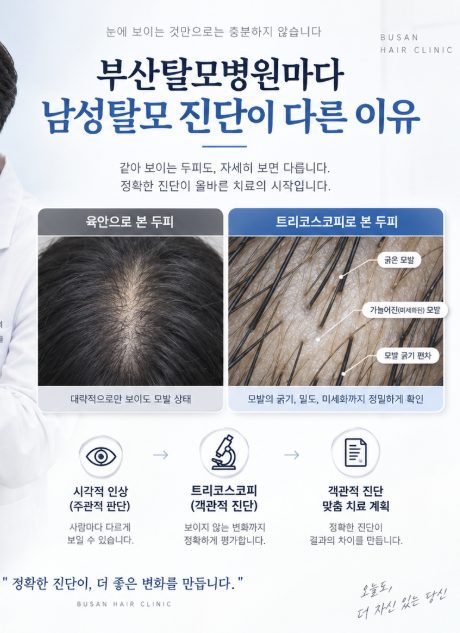
There is one more reason diagnosis comes first. In a study analyzing scalps with male pattern hair loss where almost no hair remained, the follicle stem cells that make hair were mostly still there. What had declined was the next step, in which stem cells turn into the cells that actually produce hair (Garza et al., J Clin Invest, 2011). In other words, a balding scalp is closer to dormant ground than to barren ground.
A good hair loss clinic checks the follicles that remain before the hair that has been lost.
When I ask people who have had consultations at several places, “Have you ever actually seen a magnified photo of your scalp?” a surprising number shake their heads.
Why is the type of hair loss sorted out first?
Hair loss is not one condition. Androgenetic alopecia is progressive hair loss in which follicles sensitive to DHT (dihydrotestosterone), a metabolite of male hormones, gradually shrink and the hair thins; male and female pattern hair loss belong here. By contrast, telogen effluvium, in which hair sheds all at once after childbirth, a high fever, rapid dieting or thyroid disease, and alopecia areata, in which hair falls out in round patches in specific areas in connection with an immune reaction, differ in both cause and course.
Telogen effluvium often recovers within a few months once the cause is gone, alopecia areata calls for immune-directed treatment first, and androgenetic alopecia usually progresses slowly if left untreated.
These numbers are a long way from the perception that hair loss is a problem only for middle-aged men.
Quite a few people come in saying, “Just prescribe me hair loss medication.” But as we talk, it sometimes turns out that a few months earlier they went through major stress, a sudden change in weight, childbirth or a high fever. For them, confirming the cause comes first, so before prescribing anything we look together at scalp photos and when it started.
How is diagnosing hair loss in women different?
Hair loss in women differs from men’s starting with its shape. In men it often progresses centered on the forehead and crown, but in women it often shows up as a widening part at the crown or overall thinning of the hair.
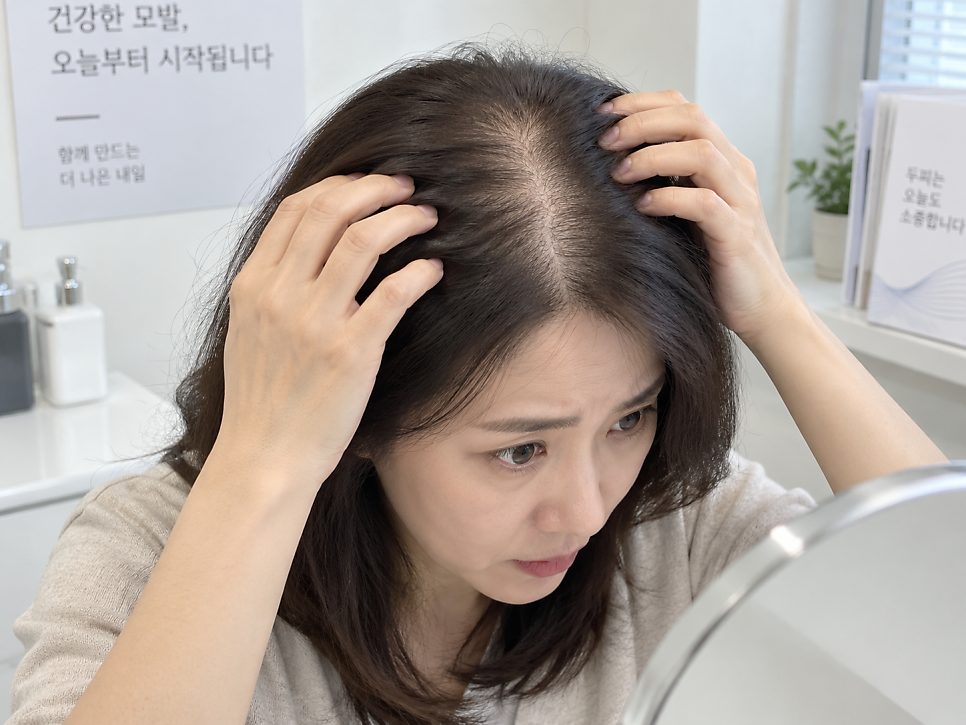
The bigger difference is the cause. In women, besides androgenetic alopecia, hormonal changes such as childbirth and menopause, nutritional status and thyroid disease can play a part together. So if the hair loss is sudden, or comes with fatigue or weight changes, other causes are checked as well with blood tests such as thyroid function, anemia and iron stores (ferritin).
The choice of medication also differs. The European dermatology guideline recommends finasteride and minoxidil for hair loss in men, and minoxidil for hair loss in women (Kanti et al., J Eur Acad Dermatol Venereol, 2018). Oral DHT blockers are contraindicated in women of childbearing age, so I always ask about pregnancy plans before prescribing.
How far have medication and PRP been confirmed?
In androgenetic alopecia, drug treatment is the treatment with the most accumulated evidence, so most clinical guidelines recommend it as the starting point. In a network meta-analysis comparing 23 clinical trials of drugs for male hair loss, oral dutasteride 0.5 mg ranked highest for efficacy, followed by oral finasteride and then topical minoxidil (Gupta et al., JAMA Dermatol, 2022). That does not mean, however, that the effect will appear in the same order for everyone.
The side effects need to be explained too. The relative risk of sexual adverse effects was reported as 1.66 for finasteride and 1.37 for dutasteride; these are generally mild and are summarized as resolving when the dose is reduced or the drug is stopped (Shin & Huh, Ann Dermatol, 2025). With minoxidil, scalp irritation and temporary shedding early on are fairly common. Effects usually start to show only after three to six months, and it takes about a year of follow-up to assess them properly.
The reason regenerative medicine is paying attention to hair loss also lies in this dormant-ground idea. In Korea, however, stem cell treatment can only be performed at designated institutions and under set procedures in accordance with the Advanced Regenerative Bio Act, and cultured stem cells cannot be used freely for cosmetic purposes.
What five things should you check when choosing in Busan?
A good hair loss clinic is one where diagnosis, explanation and measurement of progress continue as a single, unbroken flow. Whichever clinic you visit, you can ask about the five points below yourself.
First, does it determine the type of hair loss first with a magnified scalp exam? Second, does it explain both the effects and the adverse effects of drug treatment? Third, does it compare photos taken with the same lighting and the same angle every three to six months? Only then can results be described objectively.
Fourth, is it honest about the level of evidence and the limits of supplementary treatments such as PRP? It’s also worth checking that it doesn’t use absolute expressions such as “complete cure” or “100%.” The general principle is to explain well-evidenced foundational treatment first and add supplementary treatment when needed. As for cost, it is safer to ask in advance not just about the price of a single session but about the total, the number of maintenance sessions and the plan if you stop.
Fifth, is it close enough to keep visiting? Hair loss treatment goes on for a few months at the shortest and several years at the longest, so how easy it is to get to from home or work matters more than you might think.

In hair loss consultations, before “how much hair can you grow back?” I first explain “what stage are your follicles at right now?” Saeron Clinic is in Yeonsan-dong, Busan, and sees patients by appointment only.