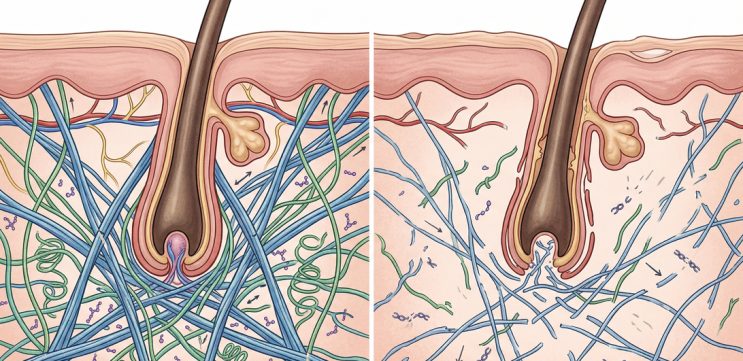







What is sudden hair shedding?
The most typical form of hair loss in women where hair suddenly comes out by the handful is telogen effluvium. Each hair goes through a growing phase (anagen) and a resting phase (telogen) before it falls out, and a new hair then grows from the same spot. Normally each hair is on its own schedule, so about 50 to 100 hairs fall out quietly each day (American Academy of Dermatology, AAD).
Think of it like shifts at a workplace: normally most hairs are on the growing shift and only a few take turns resting. But when something happens, such as an illness with a high fever, an extreme diet, childbirth or major stress, a large number suddenly crowd into the resting shift (Headington, Arch Dermatol, 1993). Then they all leave at around the same time.

What confuses patients most is the time lag. Telogen effluvium usually appears about three months after the trigger, and after childbirth it often begins between two and four months later (Rebora, Clin Cosmet Investig Dermatol, 2019). When I ask, “Did anything happen two or three months ago?” many women only then remember: “Oh, I was really sick with a bad flu back then.”
Nutritional deficiencies, thyroid problems and changes in medication are also common causes (Rebora, 2019). Acute telogen effluvium mostly recovers without any particular treatment once the cause is gone, but if it continues for more than six months, it is regarded as chronic telogen effluvium and other causes need to be looked for.
What you lost is the hair, not the factory that makes it.
What is gradual hair thinning?
Female pattern hair loss is hair loss in which the follicles that make hair slowly shrink (miniaturization), so the hair grows progressively finer and shorter. It mainly appears around the crown and the part (Ramos & Miot, An Bras Dermatol, 2015). A large share of thinning at the crown in women falls into this category.
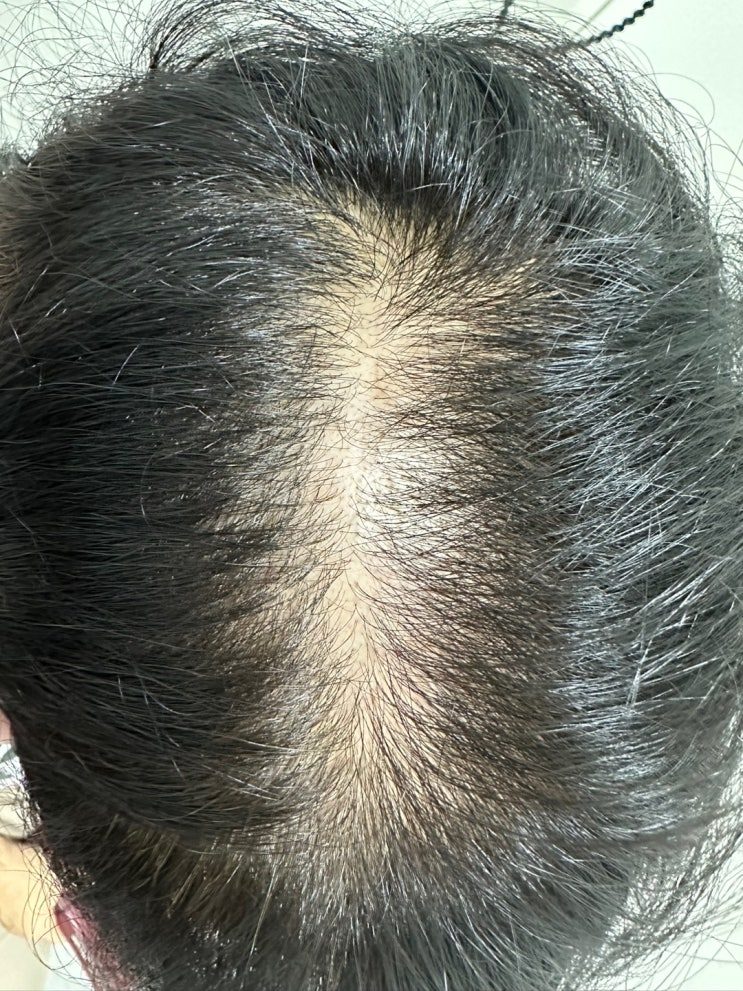
This kind of hair loss arrives without a sound. There is no sense of losing a lot of hair, and then one day the part looks wide in a photo. Many women don’t notice it looking straight into the mirror, then are startled by a photo taken from above.
Of the roughly 241,000 people treated for hair loss in Korea in 2024, about 105,000 were women (HIRA data, released by the office of National Assembly member Kim Ye-ji). To put it in terms of the analogy, telogen effluvium is a factory that has closed its doors for a while, and female pattern hair loss is a factory that is itself shrinking little by little. That’s why female pattern hair loss needs steady, long-term management.
How do you tell the two apart?
Let me give you the conclusion first: losing a lot of hair does not mean the hair loss is worse. In telogen effluvium, where hair suddenly pours out, the follicles are often preserved, so it frequently recovers better than female pattern hair loss, which thins gradually. Conversely, even if little hair falls out, if the follicles are shrinking, it needs longer management.
There are three distinguishing points you can check at home. First, if shedding suddenly increased from a certain point, think of telogen effluvium first; if it progressed gradually, think of female pattern hair loss first. Second, if the whole head thins out evenly, it is closer to telogen effluvium; if it centers on the crown and part, it is closer to female pattern hair loss. Third, if fine, short hairs are mixed in, suspect follicle miniaturization.
In women in their 40s and 50s in particular, I often see the two overlapping. A woman comes in because she is suddenly losing a lot of hair, and when we magnify the scalp, female pattern hair loss that had already been progressing is found as well. In that case, care for the part continues even after the telogen effluvium has recovered.
Piecing together the experiences of many patients, this pattern comes up often. A woman arrives frightened, saying she is losing 400 to 500 hairs a day, and it turns out that a few months earlier her body had gone through a hard time. Once the cause was corrected and treatment was given alongside, a change showed about two months later. To be honest, it is hard to separate what was due to treatment and what was natural recovery, and not everyone improves in two months.
Which tests find the cause?
“Can’t I just wait it out?” Some women certainly do get better on their own. The problem is when the cause is still there. If you are low on iron and only keep repeating scalp care, recovery will inevitably be slow. First you need to confirm whether this is hair loss you can safely wait out.
Testing goes in three directions. First, a medical interview looks for illness, childbirth, dieting or medication changes two to four months earlier. Second, a magnified scalp exam looks at differences in hair thickness and the proportion of fine hairs. This is the key step for picking up female pattern hair loss that was hiding underneath. Third, blood tests check ferritin (stored iron), anemia markers and thyroid function, and, where needed, thyroid antibodies, vitamin D, zinc and so on.
The relationship between iron deficiency and hair loss has been studied for a long time, and in clinical practice it is common to check ferritin (Trost, Bergfeld, Calogeras, J Am Acad Dermatol, 2006). However, study results are mixed on how directly iron affects hair loss, so we don’t draw a conclusion from a single value but judge it together with other findings. Female pattern hair loss can progress even when blood tests are normal, and in that case the state of the follicles and the pattern of progression are reassessed.
How much can you expect from treatment?
Hair loss treatment divides into removing the cause and helping the follicles grow again. Correcting the cause comes first; supporting growth comes next. The amount of evidence also differs from treatment to treatment. Correcting the cause is the starting point for recovery from telogen effluvium. In female pattern hair loss, minoxidil is the drug whose effect has been confirmed most often in randomized controlled studies (van Zuuren, Fedorowicz, Schoones, Cochrane Database Syst Rev, 2016). PRP, in which the platelet-rich portion of your own blood is separated and injected into the scalp, showed improved hair density in female pattern hair loss in a meta-analysis, but the differences between studies were large, and the authors concluded that larger studies are needed (Zhou et al., Front Pharmacol, 2021).
Whether PRP or follicle injections speed recovery from telogen effluvium is something the evidence is still building on. Research on adipose-derived stem cell conditioned media also reports a possible improvement in density, but the evidence is limited, so it is hard to regard it as standard treatment. Saying the evidence is still building doesn’t mean it doesn’t work; it means you should choose knowing the scope of what has been confirmed.
Even when regenerative treatment is considered, the premise is that the follicles must still be there. In scarring hair loss, where the follicles have been lost, recovery may be limited. That’s why, before asking which treatment is good, I first look at what state the follicles are in.