



Why do results differ from the same procedure?
The difference in a stem-cell procedure’s effect isn’t a matter of the stem cells alone. It varies greatly with the state of the body environment in which those cells have to work. Our body’s capacity to recover isn’t decided by stem cells alone, because immune status, nutritional status, vascular health, oxidative stress, and chronic inflammation all act together.
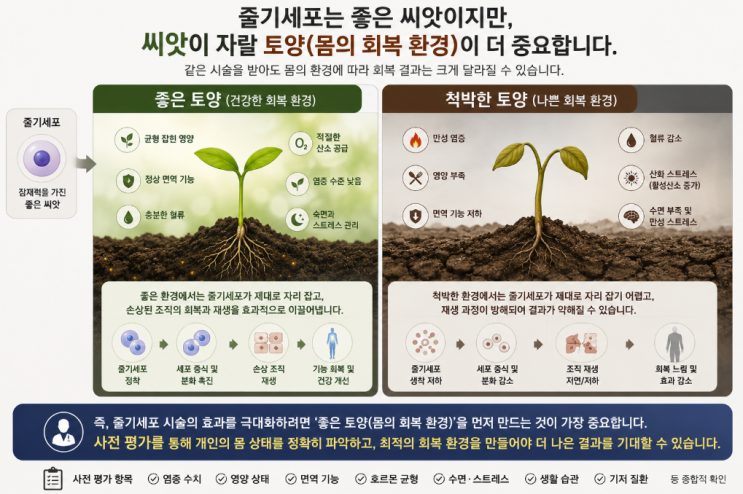
Stem cells are a good seed. They send recovery signals, modulate immunity, and steer the body toward the repair of damaged tissue. But what happens if you plant a good seed in barren ground? It doesn’t sprout well, or it grows weak even if it does. If the body is in a barren state when it receives stem cells, it’s hard to generate the recovery response you hoped for.
A good seed matters, but the soil the seed grows in matters more.
A 2025 review in the Journal of Advanced Biotechnology and Experimental Therapeutics summarized that, in the clinical application of stem-cell therapy, the cells’ own intrinsic heterogeneity, donor-to-donor variation, and cellular senescence are factors that make consistency of effect difficult. The characteristics of the stem cells themselves are one variable, but it is becoming increasingly clear in clinical practice that each patient’s own body condition determines a large part of the outcome.
How does chronic inflammation damage the recovery environment?
A 2024 review in the International Journal of Molecular Sciences summarized an interesting finding: chronic inflammation depletes stem cells, disrupts cell-to-cell communication, and shortens the telomeres, the protective structures at the ends of chromosomes. This connects precisely with the concept of inflammaging — that is, chronic inflammatory aging.
In fact, the Health, Aging and Body Composition cohort study of 1,962 older adults confirmed that people with higher inflammatory markers such as IL-6 or TNF-alpha show shorter leukocyte telomere length. It means chronic inflammation is a key driver of accelerated aging and reduced recovery capacity.
A 2025 review in Expert Opinion on Biological Therapy on mesenchymal stem cells for knee osteoarthritis also stated that a patient’s baseline condition can affect treatment efficacy. Procedural technique matters, but the common recognition among clinicians is that the patient’s body condition determines a considerable part of the outcome.
What is examined before the procedure?
Pre-procedure testing before a stem-cell procedure is not a test that scores the effect. It is a reference indicator of whether the body is ready to respond to recovery. In the clinic, we selectively carry out the following items depending on the patient’s situation.
NK activity reflects innate immune function. If it’s too low, immune surveillance and recovery capacity may be diminished. Telomeres are a biological aging indicator, and they shorten as chronic inflammation and oxidative stress accumulate. Homocysteine reflects vascular health and B-vitamin metabolism, and when high it suggests vascular inflammation and cardiovascular strain. Vitamin D and ferritin reflect nutritional and mineral status, and when deficient the recovery response itself is not readily generated. Blood glucose, HbA1c, and CRP reflect metabolism and chronic inflammation, and the higher they are, the more barren the soil.
I’m also often asked, “Can’t I just take supplements and get an IV drip — why pay for expensive stem cells?” Stem cells are not a substitute for supplements. If supplements and IV drips play the role of making the soil fertile, stem cells play the role of sending signals so that a recovery response takes place in that soil. The two are complementary, not interchangeable.
When someone with very high homocysteine or a severe vitamin D deficiency receives stem cells, there are cases where the recovery response is minimal despite the same procedure. Conversely, if nutrition and inflammation are corrected first and the procedure is repeated, the range of change can appear far greater. That’s because the soil changed.
When the tests improved but you barely feel it
Evaluating a stem-cell procedure requires looking at both the objectivity of test values and the subjectivity of how the patient feels. There are two patterns I often see in practice: cases where the tests improved but the felt experience is weak, and cases where the tests are similar but the felt experience improved far more. Both are common.
The reason is simple. Our body’s condition isn’t decided by a single number. Sleep, stress, the autonomic nervous system, hormones, gut health, and blood-glucose status all have an influence. Even if the homocysteine value improved, fatigue can remain the same if lack of sleep and stress continue. Conversely, even if the blood tests are similar, the body feels much lighter when sleep quality improves and the inflammatory response decreases.
There’s another important point. You can’t conclude that all the change after a procedure is the effect of stem cells alone. That’s because nutritional correction, sleep management, and lifestyle changes are often carried out together. A 2022 systematic review in Sports Medicine Open reported that lifestyle changes such as exercise alone can affect telomere length and telomerase activity.
What people who respond well have in common
People with high satisfaction in clinical practice share some things in common. First, they address their nutritional and inflammatory status in advance, before the procedure. Second, they manage sleep, exercise, and eating habits together after the procedure. Third, they expect cumulative change over 3 to 6 months rather than a short-term result.
A stem-cell procedure is not an instant painkiller. Because it’s a procedure that induces a recovery response, gradual improvement usually begins from around 4 to 6 weeks, and the most distinct change appears at the 3-to-6-month mark. It’s best to start knowing that this is a procedure whose effect accumulates slowly.