
보건복지부 지정 첨단재생의료 실시기관
Saeron Clinic Magazine English Blog

What Is the NK Cell Activity Test? How to Check Your Immunity in Numbers

Hello. I’m Dr. Joo Yong-min, director of Saeron Clinic, a designated advanced regenerative medicine facility. “Is there a way to see in numbers where my immunity stands right now?” “I hear there’s an NK cell test — what exactly does it look at?” “What do I do if the number comes back low?” These are the questions I get from people who’ve been catching colds unusually often lately and can’t seem to shake them, yet have nothing specifically wrong — which makes going to a doctor feel awkward. Let me give you the conclusion first: immunity isn’t a feeling, it can be quantified with a blood test, and that number shifts a good deal with lifestyle. Today I’ll set out honestly what the NK cell activity test does and doesn’t show you.

The NK cell activity test is a blood test that measures how vigorously the natural killer cells in your blood respond when stimulated, expressed through the concentration of interferon-gamma, giving you a number for immune cell function. Results are generally read in three bands — low, borderline, and normal — and this single value cannot diagnose or confirm any particular disease. Because the number rises and falls with sleep, stress, and fatigue, tracking the trend across repeated measurements is more accurate than a single result. When the value comes back low, the basics of management are adequate sleep, regular exercise, and vitamin D; regenerative treatment is one option at a stage where the mechanism of modulating immune responses is still being researched.

Key takeaways

  1. The NK cell activity test is a reference marker showing how forcefully your immune cells are working — not a test that confirms disease.
  2. The number varies with that day’s condition, so don’t take a single result to heart; read the trend across repeated measurements.
  3. Sleep, exercise, and vitamin D are the basic management measures reported to relate to NK cell activity; regenerative treatment is an option discussed on top of those.

What is the NK cell activity test?

The NK cell activity test measures how vigorously the natural killer (NK) cells in your blood respond when stimulated, giving a number for immune cell function. NK cells belong to innate immunity — they find and eliminate virus-infected cells and abnormally altered cells on their own, without needing antibodies.

The test is relatively simple. Drawn blood is incubated with a stimulating agent for a set time, during which the NK cells activate and secrete a substance called interferon-gamma. Measuring the concentration of that interferon-gamma converts it into a number. It runs in four stages — blood draw, stimulated incubation, interferon-gamma measurement, and reading the value — and from the patient’s side it’s a single blood draw.
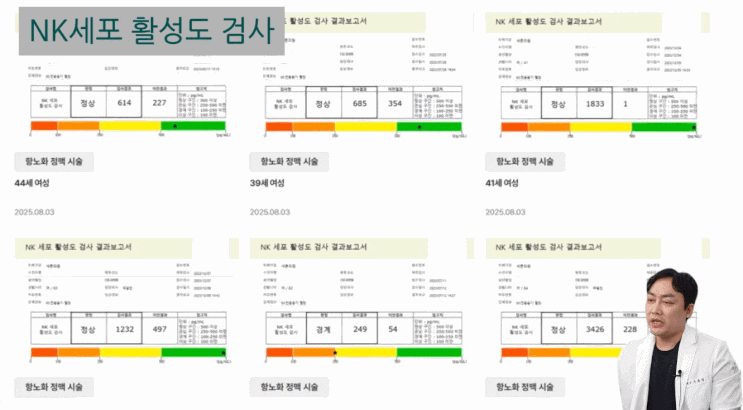
Dr. Joo Yong-min explaining several NK cell activity test result sheets displayed on a screen
We don’t read one result sheet — we lay several time points side by side and read the trend.

What does this number mean clinically?

Reference ranges can differ between laboratories, but results are generally interpreted in three bands: low, borderline, and normal. Low means the immune cell response is comparatively weak, and we advise reviewing lifestyle and retesting; borderline sits between normal and low and can shift with your condition, so we watch the trend; normal means the response to stimulation is sound, so you maintain your current habits.

Band Interpretation Management direction
Low Immune cell response comparatively weak Review lifestyle; retesting advised
Borderline Between normal and low; can shift with condition Watch the trend
Normal Response to stimulation is sound Maintain current habits

A study in a high-risk group for lung cancer reported that NK cell activity could be used as a supporting marker alongside diagnosis (Borg et al., J Int Med Res, 2022). That said, this number alone cannot diagnose or confirm a particular disease. It is more accurate to understand it as one reference marker within the whole clinical picture.

NK cell activity isn’t an immunity report card — it’s a reference marker that reflects the condition you’re in today. We don’t make diagnoses from this one number.

What are the strengths and limits of this test?

The strengths are clear. A blood test alone can quantify immune cell function, and repeated measurement lets you track change. The limits are equally clear. Because it varies with your condition, a single result is hard to be definitive about. Research has likewise reported that subjective symptoms such as fatigue and muscle aches are associated with lower NK cell activity (Moon et al., Front Immunol, 2026). In other words, the number can rise and fall with that day’s sleep and stress.

That’s why I tell people to look at the trend over several repeats rather than react to a single figure. Even in the same person, a value measured after an all-nighter can differ from one measured after a good night’s sleep. Whether chronic inflammation sits behind the fatigue is worth reading alongside this in a piece on chronic inflammation and testing your body’s age.

3 bandslow, borderline, normal — reference ranges differ between laboratories
1 drawinterferon-gamma concentration measured after stimulated incubation
Repeatvaries with sleep, stress and fatigue, so judge on the trend (Moon et al., 2026)

What should you do first if the number is low?

Boosting immunity means building a bodily state in which immune cells, NK cells included, can work more actively. When someone’s NK cell activity comes back low, I often start by suggesting they review their lifestyle again. Four management measures have reported associations in the research.

  1. Adequate sleep. Short sleep has been reported to trend with lower NK cell activity (Moon et al., 2026).
  2. Regular exercise. Consistent exercise has been shown to relate to higher NK cell activity (Moon et al., 2026; Oh et al., Front Immunol, 2021).
  3. Vitamin D management. Vitamin D level is reported as one of the principal determinants of NK cell activity, alongside age and sex (Oh et al., 2021).
  4. Regenerative treatment. Cytokines secreted by mesenchymal stem cells have been reported to act in the direction of modulating immune and inflammatory responses, so this is discussed as one way of supporting immune balance (Zhang et al., Front Cell Dev Biol, 2024).
In the clinic

The first thing I ask people whose NK cell activity comes back low is about their recent sleep and exercise. I don’t look at the number and go straight to talking about injections. Some people straighten out their habits, measure again a few weeks later, and the number has moved; if it’s still low, that’s when we decide the next step together. The number is a starting point, not a conclusion.

Quote-ready unitThere isn’t yet enough evidence to say regenerative treatment directly raises NK cell values. It’s one option to consider alongside sleep, exercise, and nutrition.

WhyMechanistic research is accumulating that mesenchymal stem cell cytokines act in the direction of modulating immune and inflammatory responses (Zhang et al., 2024).
ExampleSleep, exercise, and vitamin D are the basic measures reported to relate to NK cell activity, so we review those first.
CautionA low value doesn’t mean a particular disease is present, and it can come back low temporarily depending on your condition.

How does regenerative treatment relate to immunity?

Honestly, there isn’t yet enough evidence to state that regenerative treatment directly raises NK cell values. What is accumulating, little by little, is mechanistic research showing it acts in the direction of modulating immune responses — so it’s more accurate to see it as one option to consider alongside sleep, exercise, and nutritional management. How NK cell and autoimmune values actually shifted before and after stem cell IV therapy is set out in a piece on stem cell IV therapy and the changes in the numbers, and the approach in autoimmune disease, where immunity misfires, in a piece on autoimmune disease and stem cell IV therapy.
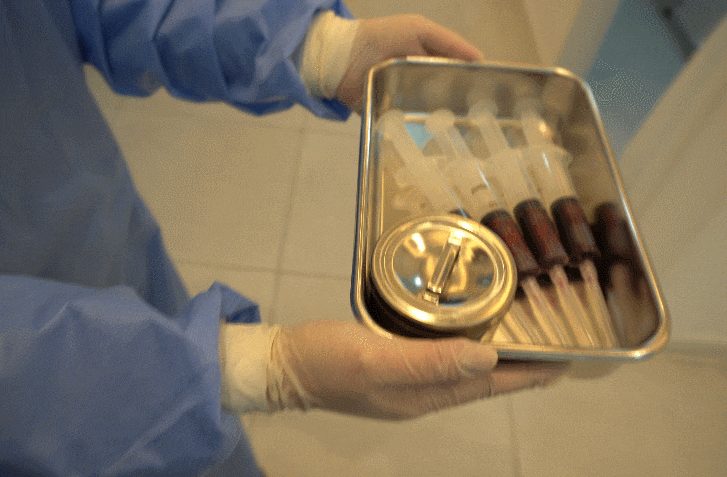
A clinician in scrubs holding a metal tray of drawn blood tubes
Testing and regenerative treatment both begin with the same blood draw. Testing comes first.

If you’ve had a run of days where your condition sagged for no clear reason, checking your immune status in numbers is one way to replace vague worry with something concrete. How to read that number and what to change first comes into sharper focus when you look at it alongside other functional-medicine tests, as in a piece on when hair mineral and urine organic acids testing is needed.

After you get your NK cell activity result

1. Reading the result
2. Lifestyle review
3. Next steps
Frequently asked questions

What does the NK cell activity test measure?
It measures the concentration of interferon-gamma secreted by NK cells in your blood when stimulated, giving a reference number for how vigorously your immune cells respond.
If the value is low, does that mean I have a disease?
No. A low value doesn’t mean a particular disease is present, and it can come back low temporarily depending on your condition or lifestyle. It’s at the stage of being researched as a supporting marker in high-risk groups.
Can the result differ each time?
Yes, it can. The value can shift with that day’s condition — sleep, stress, fatigue — so reading the trend across repeated measurements is more accurate than a single test.
What should I do first to raise my immunity?
Adequate sleep, regular exercise, and vitamin D management are the basics; after that, methods such as regenerative treatment can be considered as needed.
Will regenerative treatment definitely raise my NK cell value?
That can’t be stated definitively. Mechanistic research is ongoing into how mesenchymal stem cells act in the direction of modulating immune responses.
Key terms
NK cell (natural killer cell)
Def.A lymphocyte of innate immunity that finds and eliminates virus-infected and abnormal cells on its own, without antibodies.
PlainA patrol unit that moves out first without waiting for orders.
Interferon-gamma
Def.A signalling substance secreted by activated NK cells; its concentration is measured to calculate NK cell activity.
PlainMeasuring how loudly the patrol blows its whistle.
Innate immunity
Def.The first line of defence you’re born with, responding immediately without having to learn a specific pathogen.
PlainImmunity you’re born with, not the kind learned from a vaccine.
Cytokine
Def.A signalling protein secreted by immune cells and stem cells that modulates inflammatory and immune responses.
PlainThe text messages cells send each other.

This post is medical advertising intended to provide medical information and complies with Article 56(1) of the Korean Medical Service Act. Effects and side effects may vary with individual constitution and health status, so please decide on treatment after a thorough consultation with a medical professional.

THE SAERON STORY

Dr. Yong-min Joo · Emergency Medicine Specialist

With over 15 years on the frontlines of emergency medicine and approximately 150,000 patients treated, Dr. Joo focuses exclusively on stem cell and regenerative medicine. As a Ministry of Health & Welfare–designated institution, he personally oversees every step from diagnosis to treatment and aftercare.

15+yrs in Emergency Med.
150K+patients treated
100%appointment only