







보건복지부 지정 첨단재생의료 실시기관
Saeron Clinic Magazine Hair Loss & Scalp

Busan Hair Loss Clinic: What Criteria Should You Use to Choose One?

Hello. I’m Dr. Joo Yong-min, director of Saeron Clinic, a designated advanced regenerative medicine facility. People looking for a hair loss clinic in Busan often ask me questions like these: “Is a place with lots of reviews really the place that treats it well?” “Should I go to a dermatologist or to a hair loss clinic?” “I heard that once you start the medication, you have to take it for life?” Today I’ll lay out, honestly, criteria you can check for yourself at whichever clinic you visit.

A good hair loss clinic in Busan is not one with a long menu of procedures but one that diagnoses first. The basics are a clinic that confirms the type of hair loss and the state of the remaining follicles with a magnified scalp exam (trichoscopy), rules out other causes with blood tests when needed, and then explains drug treatment, which has the most evidence, first. Add to this comparing progress every three to six months with photos taken under the same conditions, and whether the clinic is close enough to keep visiting, and you have the five criteria for choosing a clinic.

Key takeaways

  1. Hair loss care starts not with counting the hairs that have fallen out but with identifying the type of hair loss and the state of the remaining follicles.
  2. Hair loss in women often overlaps with other causes such as anemia, thyroid problems or childbirth, so a diagnosis that includes blood tests is especially important.
  3. Drug treatment is the foundation and PRP is a supplementary treatment. Results can only be judged by comparing photos taken under the same conditions over three to six months or more.

What is checked at the first visit?

Hair loss care is not about counting the hairs that have fallen out; it is the process of identifying the type of hair loss and the state of the remaining follicles. The same worry, “my hair is falling out,” calls for completely different treatment when the cause is different. The type is determined, and a treatment plan made, through a medical interview, a magnified scalp exam and, when needed, blood tests, and the magnified scalp exam sits at the center of it.

Trichoscopy is an exam that magnifies the scalp and hair dozens of times. In an analysis pooling 34 studies covering 2,860 patients with male or female pattern hair loss, the finding of “uneven hair thickness” was observed in an average of 94% (Kuczara et al., J Clin Med, 2024). Fine hairs mixed in among thick ones are a sign that the process of follicle shrinkage has already begun.
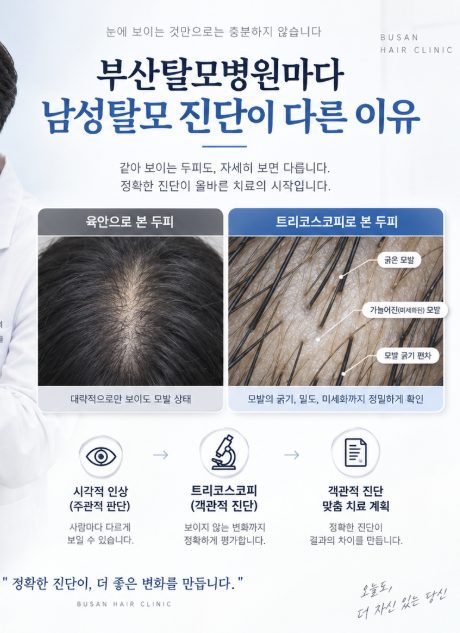
Diagnostic diagram comparing the scalp as seen with the naked eye and as seen through trichoscopy
It may look similar to the eye, but under magnification thick hairs and thinned hairs can be told apart.

There is one more reason diagnosis comes first. In a study analyzing scalps with male pattern hair loss where almost no hair remained, the follicle stem cells that make hair were mostly still there. What had declined was the next step, in which stem cells turn into the cells that actually produce hair (Garza et al., J Clin Invest, 2011). In other words, a balding scalp is closer to dormant ground than to barren ground.

A good hair loss clinic checks the follicles that remain before the hair that has been lost.

When I ask people who have had consultations at several places, “Have you ever actually seen a magnified photo of your scalp?” a surprising number shake their heads.

Why is the type of hair loss sorted out first?

Hair loss is not one condition. Androgenetic alopecia is progressive hair loss in which follicles sensitive to DHT (dihydrotestosterone), a metabolite of male hormones, gradually shrink and the hair thins; male and female pattern hair loss belong here. By contrast, telogen effluvium, in which hair sheds all at once after childbirth, a high fever, rapid dieting or thyroid disease, and alopecia areata, in which hair falls out in round patches in specific areas in connection with an immune reaction, differ in both cause and course.

Telogen effluvium often recovers within a few months once the cause is gone, alopecia areata calls for immune-directed treatment first, and androgenetic alopecia usually progresses slowly if left untreated.

241,217people treated for hair loss in Korea in 2024 (Health Insurance Review and Assessment Service, HIRA)
37.6%share of them in their 20s and 30s
~43%share of them who were women

These numbers are a long way from the perception that hair loss is a problem only for middle-aged men.

In the clinic

Quite a few people come in saying, “Just prescribe me hair loss medication.” But as we talk, it sometimes turns out that a few months earlier they went through major stress, a sudden change in weight, childbirth or a high fever. For them, confirming the cause comes first, so before prescribing anything we look together at scalp photos and when it started.

How is diagnosing hair loss in women different?

Hair loss in women differs from men’s starting with its shape. In men it often progresses centered on the forehead and crown, but in women it often shows up as a widening part at the crown or overall thinning of the hair.
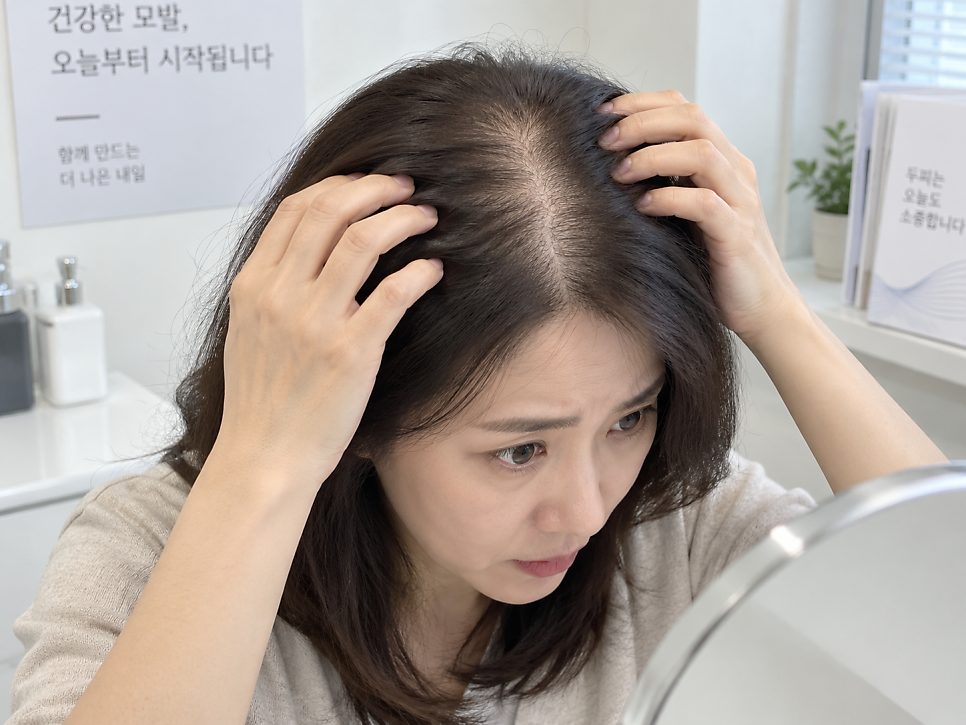
Middle-aged woman parting the hair at her crown with her hand and checking it in a mirror
In women, hair loss often shows first at the part and crown rather than the forehead.

The bigger difference is the cause. In women, besides androgenetic alopecia, hormonal changes such as childbirth and menopause, nutritional status and thyroid disease can play a part together. So if the hair loss is sudden, or comes with fatigue or weight changes, other causes are checked as well with blood tests such as thyroid function, anemia and iron stores (ferritin).

The choice of medication also differs. The European dermatology guideline recommends finasteride and minoxidil for hair loss in men, and minoxidil for hair loss in women (Kanti et al., J Eur Acad Dermatol Venereol, 2018). Oral DHT blockers are contraindicated in women of childbearing age, so I always ask about pregnancy plans before prescribing.

How far have medication and PRP been confirmed?

In androgenetic alopecia, drug treatment is the treatment with the most accumulated evidence, so most clinical guidelines recommend it as the starting point. In a network meta-analysis comparing 23 clinical trials of drugs for male hair loss, oral dutasteride 0.5 mg ranked highest for efficacy, followed by oral finasteride and then topical minoxidil (Gupta et al., JAMA Dermatol, 2022). That does not mean, however, that the effect will appear in the same order for everyone.

The side effects need to be explained too. The relative risk of sexual adverse effects was reported as 1.66 for finasteride and 1.37 for dutasteride; these are generally mild and are summarized as resolving when the dose is reduced or the drug is stopped (Shin & Huh, Ann Dermatol, 2025). With minoxidil, scalp irritation and temporary shedding early on are fairly common. Effects usually start to show only after three to six months, and it takes about a year of follow-up to assess them properly.

Quote-ready unitOn current evidence, PRP is best seen not as a stand-alone treatment replacing medication but as a supplementary treatment used alongside it.

WhyIn an analysis pooling 9 randomized controlled trials (238 participants), hair density increased significantly more than placebo at 3 and 6 months, but no clear difference was confirmed in hair count or thickness (Zhang et al., J Cutan Med Surg, 2023).
ExampleIt is combined with medication at a stage when follicles remain, and the size of the response varies from person to person (Donnelly et al., J Cosmet Dermatol, 2024).
CautionAreas where hair loss is well advanced respond less, and maintenance sessions are needed. If follicle function has largely been lost, options such as hair transplantation are considered.

The reason regenerative medicine is paying attention to hair loss also lies in this dormant-ground idea. In Korea, however, stem cell treatment can only be performed at designated institutions and under set procedures in accordance with the Advanced Regenerative Bio Act, and cultured stem cells cannot be used freely for cosmetic purposes.

What five things should you check when choosing in Busan?

A good hair loss clinic is one where diagnosis, explanation and measurement of progress continue as a single, unbroken flow. Whichever clinic you visit, you can ask about the five points below yourself.

First, does it determine the type of hair loss first with a magnified scalp exam? Second, does it explain both the effects and the adverse effects of drug treatment? Third, does it compare photos taken with the same lighting and the same angle every three to six months? Only then can results be described objectively.

Fourth, is it honest about the level of evidence and the limits of supplementary treatments such as PRP? It’s also worth checking that it doesn’t use absolute expressions such as “complete cure” or “100%.” The general principle is to explain well-evidenced foundational treatment first and add supplementary treatment when needed. As for cost, it is safer to ask in advance not just about the price of a single session but about the total, the number of maintenance sessions and the plan if you stop.

Fifth, is it close enough to keep visiting? Hair loss treatment goes on for a few months at the shortest and several years at the longest, so how easy it is to get to from home or work matters more than you might think.

View of the Saeron Clinic waiting room with a gray sofa and the reception desk
Treatment continues over months, so a place that is easy to get to is best.

In hair loss consultations, before “how much hair can you grow back?” I first explain “what stage are your follicles at right now?” Saeron Clinic is in Yeonsan-dong, Busan, and sees patients by appointment only.

Checklist before visiting a hair loss clinic in Busan

1. Before your visit
2. Check during the consultation
3. After starting treatment
Frequently asked questions

What criteria should I use to choose a hair loss clinic in Busan?
Rather than the range of procedures, it’s best to look at whether the clinic diagnoses first. A clinic that confirms the type with a magnified scalp exam and compares progress with photos taken under the same conditions can describe results objectively.
When should I see a doctor about hair loss?
Losing about 50 to 100 hairs a day is within the normal range. If shedding heavier than that continues for several weeks or more, or your part is widening and your scalp shows through at the crown, I recommend getting seen.
Is hair loss in women something a clinic treats too?
Yes. About 43% of people treated for hair loss in Korea in 2024 were women. Hair loss in women can overlap with other causes such as anemia or thyroid problems, so a diagnosis that includes blood tests is especially important, and because oral DHT blockers are contraindicated in women of childbearing age, the choice of medication differs too.
Do I have to take hair loss medication for life?
Long-term use is recommended because hair loss can start progressing again when you stop, not because you can never stop. There is also a report that finasteride kept working for close to 10 years with continued use (Shin & Huh, 2025). It can be adjusted according to age, pregnancy plans and how fast the hair loss is progressing.
Does PRP work for hair loss?
In an analysis pooling 9 randomized controlled trials, hair density increased more than with placebo, but a difference in hair count and thickness has not yet been clearly confirmed. On current evidence, it is appropriate to see it as a supplementary treatment used alongside drug treatment.
Key terms
Trichoscopy
Def.An exam that magnifies the scalp and hair dozens of times to check hair thickness, density and changes in the follicles.
PlainA magnifying glass that finds, in a photo, fine hairs you can’t see with the naked eye.
Androgenetic alopecia
Def.Progressive hair loss in which DHT-sensitive follicles gradually shrink and the hair thins; it includes male and female pattern hair loss.
PlainHair loss that slowly progresses if left alone, so steady management is the foundation.
Telogen effluvium
Def.Hair loss in which hair sheds all at once following a trigger such as childbirth, a high fever or a rapid change in weight.
PlainA temporary type of hair loss that often recovers within a few months once the cause is gone.
Ferritin
Def.A blood test marker that shows how much iron is stored in the body.
PlainA number that tells you whether your iron reserves are empty, even when your anemia markers are normal.

This post is medical advertising intended to provide medical information and complies with Article 56(1) of the Korean Medical Service Act. Effects and side effects may vary with individual constitution and health status, so please decide on treatment after a thorough consultation with a medical professional.

THE SAERON STORY

Dr. Yong-min Joo · Emergency Medicine Specialist

With over 15 years on the frontlines of emergency medicine and approximately 150,000 patients treated, Dr. Joo focuses exclusively on stem cell and regenerative medicine. As a Ministry of Health & Welfare–designated institution, he personally oversees every step from diagnosis to treatment and aftercare.

15+yrs in Emergency Med.
150K+patients treated
100%appointment only