







보건복지부 지정 첨단재생의료 실시기관
Saeron Clinic Magazine Skin Regeneration

Psoriasis Causes and Symptoms: Why It Affects More Than Skin

Hello. I’m Dr. Joo Yong-min, director of Saeron Clinic, a designated advanced regenerative medicine facility. “Psoriasis only shows up on my skin, so why does my whole body feel so heavy and drained?” “I keep switching creams, so why does it always come back to square one?” “People look at me like it might be catching. How do I explain it?” These are questions I hear often from people who have lived with psoriasis for a long time. Let me give you the conclusion first: psoriasis is a systemic inflammatory disease, an immune reaction inside the body that shows itself on the skin. Below I’ll lay out its causes and symptoms, and I’ll also be honest about where dermatology care has to come first.

Psoriasis is not just a skin disease but systemic inflammation. It is a chronic inflammatory disease in which the IL-23 and IL-17 immune signaling pathways stay switched on, so skin cells are produced far faster than normal, leaving sharply bordered red plaques covered with silvery-white scale. Normal skin turns over in about 28 days; psoriatic skin shortens that to 3 to 7 days. Because inflammatory molecules travel through the bloodstream, fatigue, itching, sleep problems, and nail and joint symptoms can appear alongside the skin. It is not contagious, and diagnosis and standard treatment start with a dermatologist.

Key takeaways

  1. Psoriasis is a chronic inflammatory disease in which the immune system keeps sounding an alarm at the skin, and it is estimated to affect 2 to 3% of the world’s population.
  2. The hallmark signs are red plaques with silvery-white scale; 84% of patients experience itching, and fatigue, joint symptoms, and nail changes can come with it.
  3. Diagnosis, severity assessment, and standard treatment belong to dermatology first. Don’t stop a current treatment on your own; start by organizing your treatment history.

Why isn’t psoriasis just a skin disease?

Psoriasis is a chronic inflammatory disease in which skin cells grow abnormally fast while a specific pathway of the immune system stays overactivated. It is estimated to affect 2 to 3% of the world’s population, roughly 125 million people (National Psoriasis Foundation, 2022).

In normal skin, new cells rise to the surface and old ones shed on a cycle of about 28 days. In psoriatic skin, that cycle shrinks to 3 to 7 days. Immature skin cells pile up, forming thick red plaques and scale.

At the center of this process are T cells and two immune signaling molecules, IL-23 and IL-17. In psoriasis this pathway never switches off and keeps sending growth signals to skin cells (Menter et al., Dermatol Ther, 2021). That’s why I don’t describe psoriasis to patients as “sensitive skin.” I describe it as “an immune system that keeps sounding an alarm at your skin.”

What you see on the skin is the result, not the cause. Psoriasis starts with an immune reaction inside the body.
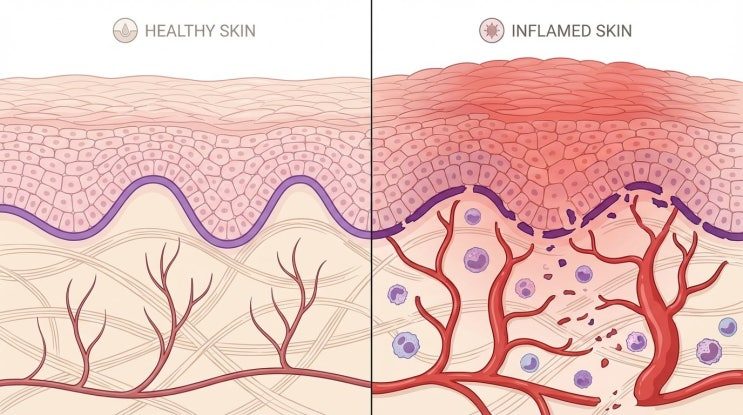
Side-by-side cross-section illustration labeled healthy skin and inflamed skin; the inflamed side shows a thickened reddened epidermis, a broken basement membrane, widened red blood vessels, and gathered immune cells
In psoriatic skin the outer layer thickens, and inflammatory signals and immune cells crowd in beneath it.
2-3%estimated global prevalence of psoriasis (National Psoriasis Foundation, 2022)
3-7 daysskin cell turnover in psoriasis, compared with about 28 days in normal skin
84%share of psoriasis patients who also experience itching (Yosipovitch et al., Br J Dermatol, 2000)

It’s a skin condition, so why is the whole body exhausted?

Inflammatory molecules made in psoriasis lesions (TNF-α, IL-6 and others) don’t stay in the skin; they circulate through the bloodstream. As they reach the brain and muscles, you can feel drained even when you haven’t done much.

One controlled study reported that fatigue in psoriasis patients was significantly higher than in healthy controls, and that this difference held independently of depressed mood or disease severity (Skoie et al., Br J Dermatol, 2017). In other words, it is a different kind of tiredness from the fatigue that follows a bad night’s sleep.
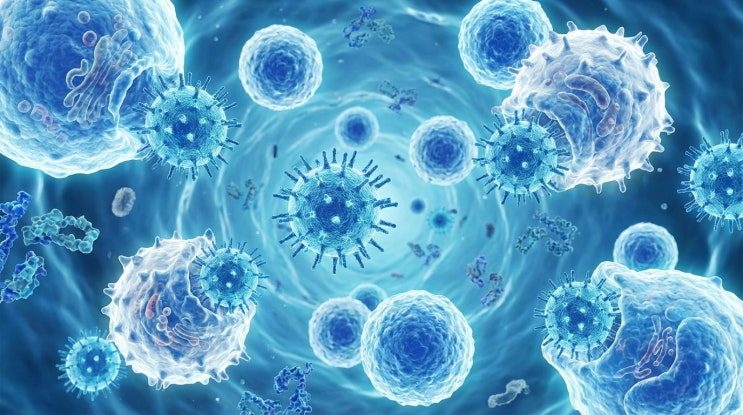
3D rendering on a blue background of round immune cells, spiked particles, and small Y-shaped antibodies floating in a swirling fluid
The inflammatory signals of psoriasis don’t end at the skin; through the blood they connect to immune responses throughout the body.

On top of that come nights broken by itching and the strain of becoming wary of meeting people because the lesions are visible. About 60% of psoriasis patients worldwide say the disease seriously interferes with daily life (National Psoriasis Foundation, 2022), and one study found its impact on physical and mental functioning comparable to that of other chronic diseases (Rapp et al., J Am Acad Dermatol, 1999).

Quote-ready unitPsoriasis is not just a skin disease but a systemic inflammatory disease involving the whole immune system.

WhyThe IL-23 and IL-17 pathways stay switched on and push skin cell proliferation, while inflammatory molecules such as TNF-α and IL-6 circulate throughout the body in the bloodstream.
ExampleFatigue in psoriasis patients was significantly higher than in healthy controls, and the difference was independent of depressed mood or severity (Skoie et al., 2017).
Caution“Systemic inflammation” does not mean contagious. Psoriasis does not spread through contact.

What are the symptoms of psoriasis, and why is the itch so bad?

The typical sign is a sharply bordered red patch (plaque) with layers of silvery-white scale on top. It tends to appear on the elbows, knees, scalp, and lower back, and when the scale is scratched off, tiny pinpoint bleeding spots may show. Some people also have thickened nails or stiff, painful joints, so signals beyond the skin need to be checked too.

And what many people find harder than the appearance is the itch. One study reported that 84% of psoriasis patients experience itching (Yosipovitch et al., Br J Dermatol, 2000). Psoriasis is, by nature, an itchy disease.

Psoriatic itch works differently from ordinary itch. Histamine is not the main driver; instead, inflammatory cytokines such as IL-17, IL-23, and IL-31 and neuropeptides such as substance P directly stimulate the sensory nerve endings in the skin. In the process, the density and reactivity of the nerve fibers in the skin are known to change (Jaworecka et al., Int J Mol Sci, 2021; Szepietowski and Reich, Eur J Pain, 2016).

That’s why antihistamines that work well for hives often have only limited effect on psoriatic itch (Domagała et al., Adv Dermatol Allergol, 2017). A sedating medication can play a supporting role by helping you sleep, but it does not treat psoriasis itself. If you just put up with the itch, scratching can feed the inflammation again and set up a vicious cycle.

How is moderate to severe psoriasis assessed?

Moderate to severe psoriasis is psoriasis that covers a wide area, or involves high-impact sites such as the hands, feet, face, scalp, or genitals, and is hard to control with topical medication alone. Involvement of 10% or more of body surface area is one commonly used threshold, but even a small area is rated as more severe if it affects those sites or has a large impact on quality of life.

The burden at this stage isn’t explained by lesion size alone. Psoriasis is a disease that many patients say affects their quality of life (Lebwohl et al., J Am Acad Dermatol, 2014). People hesitate to wear short sleeves, worry about scale falling on clothes and bedding, and carry fear of relapse and a sinking mood along with it.

In the clinic

Quite a few psoriasis patients come in wearing long sleeves and long trousers even in summer. When I listen to them, what is harder than the lesions themselves is the moment they have to show their scalp at the hair salon, or having to explain every time that it isn’t contagious. When I hear that, the first thing I tell them is that this isn’t a difficulty that comes from being oversensitive. It is the real burden of a disease whose symptoms are visible.

Where should diagnosis and treatment start?

I’ll be honest with you: diagnosis and standard treatment for psoriasis start with a dermatologist. Topical medications, phototherapy, oral medications, and biologics are treatments with proven effectiveness, chosen step by step according to symptoms and severity (Armstrong and Read, JAMA, 2020). If you also have joint pain, you may need to see a rheumatologist as well. Stopping your current treatment on your own can make symptoms flare again, so any change in treatment must be discussed with your treating physician.

Many people relapse even after switching from one medication to another. In that case, before switching again, the first step is to organize your treatment history: which medications, how much, and how you responded. What gets considered after steroid creams is covered in a follow-up piece on why psoriasis treatment keeps relapsing.

Regenerative medicine is not yet standard treatment in this area. Because psoriasis begins as an immune problem, the immune-modulating properties of mesenchymal stem cells have been a subject of research, and small clinical trials in psoriasis patients have been registered and conducted (ClinicalTrials.gov). The studies are small, though, so I can’t state the effect or how long it lasts with any certainty. Advanced regenerative medicine is performed only within the procedures and range of eligible conditions set by law, and it is one option you can discuss, not a replacement for existing treatment. For the research on how immune markers change, see a piece on autoimmune disease and stem cell IV therapy.

Psoriasis: what to prepare before your appointment

1. Record your symptoms
2. See a dermatologist
3. Before the next step
Frequently asked questions

Is psoriasis contagious?
No. It is a chronic inflammatory disease tied to the immune response, so it does not spread through skin contact or shared facilities such as public baths or swimming pools.
Psoriasis is a skin disease, so why am I so tired?
Because inflammatory molecules made in the lesions circulate through the whole body in the bloodstream. One study found fatigue in psoriasis patients was significantly higher than in healthy people (Skoie et al., 2017).
Do antihistamines help psoriasis itch?
Often only to a limited degree. Psoriatic itch is driven mainly by inflammatory signals such as IL-17, IL-23, and IL-31 and by nerve responses rather than histamine. Sedating medications play a supporting role in helping you sleep.
Does scratching make psoriasis worse?
It can. Scratching can feed the inflammation so that lesions and itch worsen together. If itching lasts more than three months or disrupts your sleep, I recommend discussing the itch itself as a treatment goal.
Will regenerative treatment get rid of psoriasis completely?
I can’t tell you that. Psoriasis is a chronic disease that improves and worsens in cycles, regenerative treatment is not yet standard care, and its effect and duration have not been established. Dermatology care and existing treatment come first.
Key terms
Psoriasis
Def.A chronic inflammatory disease in which immune dysfunction makes skin cells form abnormally fast, producing red plaques and silvery-white scale.
PlainAn immune system that keeps sounding an alarm at your skin.
Scale
Def.Flaky, layered keratin formed when immature skin cells pile up on the skin surface.
PlainSkin that rose too fast and couldn’t shed in time.
IL-17 and IL-23
Def.Immune signaling molecules linked to T cells; in psoriasis this pathway stays active and drives skin cell proliferation.
PlainA fire alarm that never stops ringing.
Moderate to severe psoriasis
Def.Psoriasis that is widespread or involves sites such as the hands, feet, face, or scalp, and is hard to control with topical medication alone.
PlainA measure that weighs the impact on daily life, not just the area covered.

This post is medical advertising intended to provide medical information and complies with Article 56(1) of the Korean Medical Service Act. Effects and side effects may vary with individual constitution and health status, so please decide on treatment after a thorough consultation with a medical professional.

THE SAERON STORY

Dr. Yong-min Joo · Emergency Medicine Specialist

With over 15 years on the frontlines of emergency medicine and approximately 150,000 patients treated, Dr. Joo focuses exclusively on stem cell and regenerative medicine. As a Ministry of Health & Welfare–designated institution, he personally oversees every step from diagnosis to treatment and aftercare.

15+yrs in Emergency Med.
150K+patients treated
100%appointment only